Showing posts with label Women's Prize for Fiction. Show all posts

Friday, 20 October 2023

Hamnet, Maggie O’Farrell

This post contains affiliate links. If you click through and buy I will receive a percentage commission at no extra cost to you.

A boy runs to find his family, nowhere to be found. A young man falls in love with a local woman. These two stories run in parallel, years apart. Hamnet’s father meets Agnes while working as a Latin tutor. She is older and considered strange by the locals. A pregnancy forces her family’s hand and soon they find themselves married. Later, the father works in London as his daughter lies dying of the plague. Hamnet’s mother has the gift to see what others don’t, and had always believed there would be two children with her at her deathbed. Judith’s turn in health suggests her three living children might soon become two. This storyline moves forward at a slower pace until the young versions of his mother and father almost catch them up. 

Agnes, more commonly known as Anne today, struggles to fit in to town living. She has grown up with nature and feels that connection deeply, taking herself into the woods to give birth to her first daughter alone. She is strong-willed and intelligent, and we see the passion between her and her husband, something history has often forgotten. Her husband has a difficult relationship with his father but he is driven to succeed. They plot for him to move to London, a decision that Agnes comes to regret. After Hamnet’s death his letters home become increasingly infrequent and lack any real detail. What feels like abandonment could instead be a struggle to deal with grief. O’Farrell takes the scant facts we have about these lives and expands them, makes them relatable and rounded, creates a relationship with depth and pain, and real love.

The relationship between Judith and Hamnet is sweet. We see them growing up, playing tricks on the rest of the family, pretending to be the other. Focussing on the possibility of Judith’s demise is an interesting curveball, and the shift to Hamnet is all the more painful for its having snuck up on the family. There is a brief interlude explaining how the plague reaches them and it is quite remarkable. After Hamnet’s death we don’t see much of Judith’s experience, but what we do is heartbreaking. Her desire to be reunited with Hamnet, her feeling that she has lost part of herself, is all the more poignant for the way in which their positions switched.

When news of her husband’s latest play reaches Agnes she is distraught that he has taken their son’s name to use in such a way, that he wouldn’t even have mentioned it to her before advertising. This section considers the way in which we remember those who are no longer with us. This play which at first seems to have no part of her son in it proves to be a moving memorial, and a way for both parents to come back together, an unspoken understanding between them.

O’Farrell's prose is beautiful. She builds a story about one of the most famous writers ever to have lived but makes it feel like it could be any family. The fraught relationships with elders in the family, the desire to find their own way in life, and the judgment and care of the local community, all this normalises a remarkable family. Renown does not protect against misfortune and heartbreak. This is a very human story.

Pick up a copy:
Foyles
Waterstones

Saturday, 19 August 2023

Demon Copperhead, Barbara Kingsolver

This post contains affiliate links. If you click through and buy I will receive a percentage commission at no extra cost to you.

Kingsolver’s award-winning novel takes us on a journey with young Demon, told to us by him at a distance of some years. He is born and raised in Lee County to a mother with drug addiction problems and an abusive partner. Life is never easy for him as he is taken in to a social care system which is light on care. His guardians are more interested in the cheque that comes with him than his welfare. Will he be able to find a way out of the life that he sees as set for him?

A lot of space has been given to comparisons with Dickens’ David Copperfield, the blueprint for this novel. I have not read it and do not feel it lessened my experience of Kingsolver’s novel. It is interesting to note, however, that she admits to having felt stuck in how to tell this story, and that Dickens proved to be the key to unlock it. Author of great social novels, shining a light on the suffering of the less fortunate in and around nineteenth century London, Kingsolver’s novel has the same aspiration for modern-day Appalachia. In this she is successful, the book offers us sight of what life is like for a generation of children whose parents' lives have been disrupted with devastating consequences by the opioid crisis forced upon them. Using a first-person narrative brings us close to Demon and creates compassion and understanding where previously there may only have been judgment. 

Kingsolver is open about the fact she was hoping to change the narrative of blame with this novel. The OxyContin crisis was manufactured by capitalists unconcerned with the lives they were destroying. Addiction began with legal prescriptions, following the advice of doctors. The character of June reminds Demon (and us) that this was done to him, to all of them. This isn’t a subject I was aware of before reading Demon Copperhead but there are plenty of resources for the curious, perhaps most notably Dopesick by Beth Macy. 

As Demon and his friends age they become aware of how they are viewed by the rest of the world, how they are so often the butt of the joke. Tommy, a friend made at an early care placement, is particularly distressed by this revelation and worries that people will judge him for it. Demon’s experiences highlight how much of this comes from ignorance. He finds cities dangerous and sad for their lack of nature, offering the opposing view, that city life doesn’t mean better. He notes that poor people in the cities have no way of getting food, in the country they can grow their own. 

All the characters have a difficult time one way or another, from abused women, children whose parents have been incarcerated or died, grandparents taking on the burden of care, and the countless people just trying to keep their head above water. It is a hard environment to grow up in, but it is also one where community is at the heart of life. Church groups provide free lunches for children who would otherwise go without, women make quilts for newborn babies, and everyone brings food to a wake. Desperation, addiction, and want make people behave recklessly, but there’s generosity and kindness too.

In this way the book is about so much more than the life of one man, but Demon’s story will nonetheless grip you. He is a good-hearted character trying to do his best for the people he loves, even when their behaviour is damaging to him. You rage at the injustices he experiences as child and your heart breaks as his life goes into decline after a period of success. We watch as he develops emotionally from repression of deep sadness in his youth to the anger he frequently feels. He makes mistakes as any young person does. We see how the lack of a safe environment impacts his mindset and the realisation of how others, within his own community, see him. Always we want the best for him, to find security and safety, to be loved.

This is a brilliant, challenging read. A rare book that you can feel changing you as you read it. If ever there were evidence of the power of fiction, this is it.

Friday, 29 April 2022

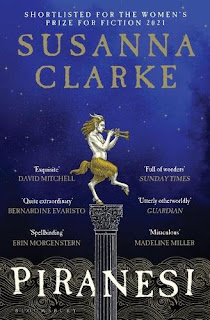
Piranesi, Susanna Clarke

This post contains affiliate links. If you click through and buy I will receive a percentage commission at no extra cost to you.

We meet Piranesi in the depths of a mythical feeling world, the House, in which his only companions are birds, statues, and the Other, a man he meets a couple of times a week but who doesn’t seem to know the surrounds as thoroughly as Piranesi. Indeed, he is the one who named him Piranesi, who knows it is not his real name but can’t remember what is. The Other also seems to have access to a lot more resources than Piranesi - using something that appears to be a smartphone or tablet, wearing quality clothes, and seemingly having provided a sleeping bag and fish fingers for one of the thirteen dead. Prianesi, on the other hand, satisfies himself with using seaweed to mend things and fishing for sustenance. Despite his meagre, solitary existence, Piranesi is largely quite content. He keeps a thorough journal and records data for the Other. He even creates a sort of religion for himself, looking after the remains of the dead and bringing them offerings. 

The opening fifty pages or so are quite baffling, with Piranesi’s way of keeping track of time and naming the halls being long and unwieldy (e.g. the eighteenth day of the fifth month in the year the albatross came to the south-western halls). Piranesi’s own obliviousness to the reality of his existence leaves the reader similarly unaware, but curious and constantly coming up with theories. As the story unfolds and things begin to become clearer both the reader and Piranesi start to uncover the truth. It is dark and unpleasant, but Piranesi manages to maintain an optimistic, caring outlook.

The Other seems intent on unsettling him, claiming that there is one more living in the House but that they wish them both harm, that if Piranesi so much as talks to them he will descend into madness. As much as the reader doesn’t know who the Other is or what his intentions are, you feel that he is not really looking out for Piranesi. He appears largely indifferent to him except when it comes to this person, nicknamed 16. Piranesi’s innocent trust in him can be difficult to read as he naively follows his instructions and makes it harder for himself to discover the truth.

The characters are interesting, and the drip feeding of information is tantalising. It puts you on an even footing with Piranesi - you are not given any information that doesn’t come to you through him, yet it is likely you’ll approach the events with a greater degree of suspicion. Piranesi is kind to a fault, continuing to try and protect those who have harmed him, although that might have more to do with Stockholm syndrome. His story examines the ways people cope with trauma and hardship, and his attachment to the House feels realistically drawn.

A book with an unreliable yet endearing narrator. Reading this will enter the reader into a strange and mind-bending world in which you will find yourself constantly questioning. Somewhat difficult to get in to, once it hooks you you won’t want to put it down.

Pick up a copy:
Bookshop
Waterstones

Wednesday, 5 August 2020

Girl, Edna O’Brien

This post contains affiliate links. If you click through and buy I will receive a percentage commission at no extra cost to you.


O’Brien’s latest novel, although not explicitly named in the book, is based on the abduction of 276 school girls by Boko Haram in Nigeria in 2014. It opens with a description of the night they were taken, one girl jumping out of the truck into the unknown to escape the horrors ahead. What follows is a harrowing account of gang rape, stoning, and the daily cruelties inflicted. It is hard reading yet unputdownable. The narrative isn’t linear as our narrator, Maryam, attempts to find freedom while experiencing repeated flashbacks and ostracisation because of what happened to her.


We are forced to witness great suffering just as the other girls are made to watch their peers undergo abuse, knowing they will soon be suffering similar. Later, we are told that their abusers sometimes film their attacks, laughing and gloating, witnessing for pleasure instead of fear. They have all the power and take any opportunity to humiliate the girls. The presence of smart phones also offers a stark reminder that this wasn’t centuries ago but continues today.


There is no comfort for the girls. Maryam describes her experience of childbirth, of the uncaring women acting as midwives who leave as soon as the placenta has been removed and who made her clean the room of the mess of labour. This is one example of many that highlight how they are mistreated and made vulnerable with no reprieve or chance of human sympathy.


The tone is dispassionate, suggesting a numbing experience often brought on by trauma, and she tells us that when telling her story to officials she leaves out details of the repeated sexual assaults. In a celebration of her return she is told many times not to mention anything too gruesome, people do not really want to know the truth. Indeed, she finds that her relationship with her mother has become fraught as they both try to process what has happened. She is rejected and seen as suspicious by many, O’Brien carefully showing that it doesn’t end with the celebratory footage of their return - the consequences of their captors’ actions will follow them through life.


O’Brien has come under some criticism for writing a book from the point of view of a character whose life is so different from her own, but it is done sensitively, with careful research. She comments in interviews that she felt compelled to write it, to tell the stories and bring the cause to the forefront of people’s attention. An unflinching portrayal that demands your attention.


Pick up a copy:

Foyles

Waterstones

Sunday, 14 July 2019

Circe, Madeline Miller


This post contains affiliate links. If you click through and buy I will receive a percentage commission at no extra cost to you.

In Madeline Miller’s latest reimagining she takes Circe, daughter of the sun god Helios, a character who fills only a few lines of Homer’s The Odyssey and puts her centre stage. An outcast among the gods for not being beautiful enough and the misfortune of having a mortal voice, she finds peace in her island of exile, Aiaia, but only when the gods allow it. Through her story we meet many famous characters – Scylla, Odysseus, Jason, and the minotaur birthed by her sister. Her story is in many ways a sad one but also one in which she proves her resilience and power.

Her separation from other divine beings gives her an appreciation of mortal values. She comments that they have to work hard to hone their skills but because gods are born with excellence they instead work on proving what they can destroy. They do not have empathy as mortals do, yet Circe does show some. Early on we witness the punishment of Prometheus, Circe alone takes pity on him. Penelope comments that Odysseus told her ‘that he had never met a god who enjoyed their divinity less.’ Her views on the division of mortals and gods is forged in her youth as she is rejected and abused by her kin, reinforced by her transformation of Glaucos from mortal to god and his simultaneous loss of love for her. At a number of points she seems to yearn for mortality. She envies the way mortal bodies have their history written on them, and that part of them doesn’t die but lives forever in the underworld, where she can never go. She shows us a different side to divinity and she is made to be more relatable to the reader.

The other main theme is that of the position of women. Even goddesses are seen as lesser beings. When nymphs are sent to Aiaia as punishment Circe reflects that having misbehaving daughters sent to her is preferable to sons, swiftly followed by the truth that it never would have been sons, as they are not punished. It is not merely moral expectation that is different but for females there is a very real risk of assault. Hermes jokes with her that nymphs always run screaming when he tries to take them to bed but that they are terrible at getting away. When sailors come to the island and realise she is alone, despite her power they try to rape her and hope to steal from her. This experience makes her more vengeful, turning dishonest men into pigs. In this way she takes back some control, although she acknowledges that she is always under the dominion of the gods.

Circe's story is told to us as a first person narrative and we experience the heartache and desire for control as her life goes through its many turmoils. At times it is hard to remember that the story unfurls over centuries, but unlike many of the other gods she seems develop emotionally over the years, making her a far more interesting protagonist. Not perhaps as gripping as I’d imagined it might be, nonetheless an interesting read that makes you think again about the mythology we’re taught in our youth.

Pick up a copy: