Friday, 24 November 2023

The Confessions of Frannie Langton, Sara Collins

This post contains affiliate links. If you click through and buy I will receive a percentage commission at no extra cost to you.

Frannie Langton is born into slavery on a plantation ironically named Paradise. There she witnesses extreme cruelty. She learns to read, and as a result is forced to help Langton with his experiments, the horrors of which haunt her throughout. The plantation burns down and she is taken to London where legally she is free but Langton nonetheless gifts her to his rival Mr Benham. We know from the start that she is on trial for the murder of Mr and Mrs Benham and this colours the way we watch their relationship develop. She sees how unhappy Mrs Benham is in her marriage and as they grow closer a physical attraction develops. She is judged by the other servants in the household, and the two of them descend into opium addiction, yet it is a cruel turn of fate orchestrated by Mr Benham that seems likely to push them both over the edge. 

The circumstances of the murder are hazy. Frannie doesn’t remember what happened, and the witnesses pointing fingers are basing their assumptions on circumstantial evidence and prejudice. Frannie’s confessions are her opportunity to give voice to her life. She resents the people who take on the role of white saviours, revelling in hearing tales of suffering, making money from the misery of others. She wants her life to be understood fully, not to be mere entertainment, a way for people to feel better about themselves. Her writing is passionate and engrossing. Her life has undoubtedly been difficult, the people around her treating her terribly, but she is so much more than what has been done to her. 

She is not used to receiving affection. Growing up not knowing who her mother is, after the loss of another slave in the house at Paradise, Langton becomes her closest acquaintance. His experiments aim to prove that people of colour are not human as a way of justifying slavery and ill-treatment. He sees that Frannie is intelligent and in private speaks to her with some degree of respect, but as soon as he is in the company of white men she is treated as invisible. The fact he gifts her to Benham shows that he never really saw her as anything more than a possession he could use to his own advantage. She is left with a feeling of confusion, of temporary sorrow at his exit from her life. The lingering emotion however is guilt, shame at what they did together, an inability to absolve herself of responsibility for the actions she was forced to perform. There is a sense that she is willing to take the blame for a murder she may not have committed as punishment for the evil deeds she’d witnessed and been forced to participate in.

The women in the houses where she lives are unhappy and bored, a very dangerous circumstance for those who serve them. They have no love for their husbands and take steps to try to avoid pregnancy, taking what little control they can. Mrs Benham is forced to perform her role as a good wife and hostess even when she is suffering, and Mr Benham’s attempts to save face descend into cruelty. Frannie sees this and feels for the woman she has come to care for deeply. Their relationship is a difficult one, and far from being equal. When Frannie finds herself alone she realises how little opportunity there is for women of colour to even buy themselves a drink, let alone find work that doesn’t involve satisfying the sexual whims of wealthy men.

Her life is hard and full of suffering, disappointment, and rejection, yet she is defiant. She knows that she is capable and intelligent and will do what she must to survive. Her confessions are powerful. Langton and Benham are fictional characters but their actions reflect experiments that were carried out around this period. A haunting, disturbing book. Well written and with characters that feel real, this is an impressive debut. 

Friday, 20 October 2023

Hamnet, Maggie O’Farrell

This post contains affiliate links. If you click through and buy I will receive a percentage commission at no extra cost to you.

A boy runs to find his family, nowhere to be found. A young man falls in love with a local woman. These two stories run in parallel, years apart. Hamnet’s father meets Agnes while working as a Latin tutor. She is older and considered strange by the locals. A pregnancy forces her family’s hand and soon they find themselves married. Later, the father works in London as his daughter lies dying of the plague. Hamnet’s mother has the gift to see what others don’t, and had always believed there would be two children with her at her deathbed. Judith’s turn in health suggests her three living children might soon become two. This storyline moves forward at a slower pace until the young versions of his mother and father almost catch them up. 

Agnes, more commonly known as Anne today, struggles to fit in to town living. She has grown up with nature and feels that connection deeply, taking herself into the woods to give birth to her first daughter alone. She is strong-willed and intelligent, and we see the passion between her and her husband, something history has often forgotten. Her husband has a difficult relationship with his father but he is driven to succeed. They plot for him to move to London, a decision that Agnes comes to regret. After Hamnet’s death his letters home become increasingly infrequent and lack any real detail. What feels like abandonment could instead be a struggle to deal with grief. O’Farrell takes the scant facts we have about these lives and expands them, makes them relatable and rounded, creates a relationship with depth and pain, and real love.

The relationship between Judith and Hamnet is sweet. We see them growing up, playing tricks on the rest of the family, pretending to be the other. Focussing on the possibility of Judith’s demise is an interesting curveball, and the shift to Hamnet is all the more painful for its having snuck up on the family. There is a brief interlude explaining how the plague reaches them and it is quite remarkable. After Hamnet’s death we don’t see much of Judith’s experience, but what we do is heartbreaking. Her desire to be reunited with Hamnet, her feeling that she has lost part of herself, is all the more poignant for the way in which their positions switched.

When news of her husband’s latest play reaches Agnes she is distraught that he has taken their son’s name to use in such a way, that he wouldn’t even have mentioned it to her before advertising. This section considers the way in which we remember those who are no longer with us. This play which at first seems to have no part of her son in it proves to be a moving memorial, and a way for both parents to come back together, an unspoken understanding between them.

O’Farrell's prose is beautiful. She builds a story about one of the most famous writers ever to have lived but makes it feel like it could be any family. The fraught relationships with elders in the family, the desire to find their own way in life, and the judgment and care of the local community, all this normalises a remarkable family. Renown does not protect against misfortune and heartbreak. This is a very human story.

Pick up a copy:
Foyles
Waterstones

Thursday, 28 September 2023

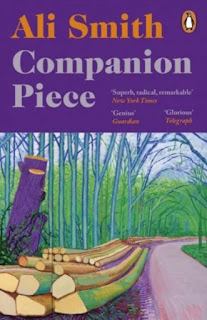
Companion Piece, Ali Smith

This post contains affiliate links. If you click through and buy I will receive a percentage commission at no extra cost to you.

Smith’s latest offering follows in the footsteps of her Seasonal Quartet. This is a novel written in real-time, dealing with the Covid pandemic, but with Smith’s characteristic ability to connect the present with a broader history. Our protagonist, Sandy, is an artist whose father is in hospital following a heart attack. She is unable to visit due to Covid restrictions, and so awaits news from a nurse, occasionally able to video call. Out of the blue, she receives a call from someone she barely knew at college, wanting to tell her a bizarre story about a recent ordeal in an airport, believing that Sandy will be able to make sense of it. Before she knows what is happening, her home is invaded by Martina’s family, none of whom take the pandemic seriously and so she relocates to her father’s house, afraid of becoming ill and not being able to see her father. We are then transported back to the seventeenth century and a promising young blacksmith being forcibly removed from her forge. It highlights the gender injustices of the time and the resilience of the young woman during a period of plague. 

Covid is present in the novel, yet it doesn’t feel like the main purpose. The Pelf family are an extreme version of people completely oblivious to the needs of others, taking over Sandy’s house without a second thought. The twins are suspicious, accusatory, and very much of their generation in the way that they speak, work, and view the world. They have the sense of invincibility that comes with youth for many. Despite having had Covid and continuing to suffer symptoms, there are no precautions taken, no concern that they’re co-habiting with someone currently suffering from it. They are blind to the world at large as well as to Sandy’s needs, it doesn’t occur to them that she needs to be particularly careful so she can visit her unwell father. They inhabit a world of entitlement, to their mother as she has been, to other people’s attention.

Sandy doesn’t have children but this theme of cross-generational relationships appear for her not just through her interactions with the young Pelfs, but also with her own father. She is an artist, using the words of great poets to create meaningful visual representations, but her father struggles to understand her chosen path in life, bemoaning the potential that he perceives as being wasted. There is affection between them but also a distance, a misunderstanding of each other’s world view and expectations that will be familiar to many readers.

Martina’s experience at the airport, being detained for having passports from two different countries, touches on familiar ground for Smith - the bureaucracy and abuse of it that often leads to human suffering, suspicion of those from other countries. To a lesser extent we also see the culture of surveillance in the work of one of the twins, constantly monitored for productivity and pulled up if they fall below the set rate. In the historical setting, we see the whims of bureaucracy causing terrible consequences for our heroine. With her mentor dead, people circle wanting to take the forge away from her. At the time, her virginity was essential for her to continue as an apprentice, and so a plot is devised to ensure she cannot continue in her position. Power will always be abused by those who wield it.

Smith examines the use of language and the way it has changed. There is discussion by the characters of the way grammar is so fluid but that the use of they/them in the singular is nothing new. The use of text speak (ey em oh etc) in spoken language feels ridiculous when written down, and the constant need to explain to Sandy what the abbreviations mean make any time saved entirely wasted. Social media is touched upon lightly, from the sharing of (mis)information to its perceived necessity in being successful in life. It forces us to consider the way we connect with our fellow humans, and the value of words.

Smith presents events from recent times in a way that feels like satire, but depressingly are fact. The book is littered with references to current events, almost without comment yet with great feeling behind them. This is an intriguing novel, and one in which I could happily read more of both stories. The Pelfs are infuriating, Sandy is a bit of an enigma, and the girl in the past has so much potential in a world that would rather restrict it. The connection through time is wrapped up at the end, but there is much still to wonder about how their stories end. 

Friday, 15 September 2023

The Salt Path, Raynor Winn

This post contains affiliate links. If you click through and buy I will receive a percentage commission at no extra cost to you.

Edit: In July 2025 The Observer published an investigation into the claims made in this book regarding how the couple lost their home.The text of the below review remains in its original form, as published in 2023, before these allegations came to light.

Raynor Winn and her husband Moth’s lives fall apart when they lose a legal battle due to a technicality in submitting evidence, losing them their home. They receive another huge blow when Moth is diagnosed with an incurable degenerative disease, all within a matter of days. When the bailiffs come to their home a walking book provides the inspiration they need to keep moving forward. They soon find themselves on the South West Coast Path, walking from Minehead to Land’s End, and after that who knows? It’s a dramatic, emotional start to a book that will shine a light on people’s misconceptions of those who become homeless.


Ray naturally struggles to accept the imminent loss of her life partner, and it takes most of the 630 mile walk for them to be able to openly speak the words. Their two children, young adults living their lives in shared houses, seem to have made their peace with it, but we see events through Ray’s eyes and so this doesn’t become clear until she’s able to face it. The weight of their loss haunts them, but she acknowledges how it impacts their children, the loss of security of having a home to go back to if they need it. Unable to offer their parents somewhere to stay, they look on from afar, occasional calls keeping them in touch. They might struggle to understand what their parents are embarking upon, but they support them.


It might seem like a strange idea, to be advised by a doctor not to over-exert yourself, to take it carefully on stairs, to decide to walk a punishing route, wild camping and barely eating on their £30 a week. And yet, Moth becomes healthier than he has been in a long time, the pain in his shoulder ever present but not stopping him. He loses weight and becomes more muscular as they carry heavy packs over steep cliffs and through dense woodland. Ray doesn’t shy away from the fact it is difficult. Paddy Dillon’s book, their guide, underplays the intensity of the path, he races ahead of them as they slowly wend their way along the coast. They live mostly off noodles, rice, and tuna, learning to take pleasure in watching others eat food that is far out of their reach. 


There’s plenty of humour to be found too. Their long-running saga of people mistaking Moth for Simon Armitage, a name they’re not familiar with, leads them into some strange scenarios, including Moth receiving a massage from a local business owner’s assistant. They come to assign categories to other walkers they encounter, many of whom are so focussed on racing across as many miles as possible that they miss out on so much of the value of doing it. They meet a range of characters along the way, from those who are friendly until they mention their situation to familiar faces they see again and again, and an unfortunate amount of early dog walkers who always seem to appear at the worst possible moment. They are repeatedly told how old they are, and how lucky to have the luxury of time, the freedom to keep walking until they choose to stop rather than having to rush back to jobs. The reality is that the end point is scary because after it they don’t know what happens.


As time passes they notice that they are far more comfortable in the more remote areas of the path, being around a lot of people puts them on edge. A mix-up with a ferry means they have to sleep in a town one night and it leaves them shaken and wondering how people do it night after night. Despite having next to nothing themselves, whenever they can help others they do, sharing their meagre rations of food. They’re also met with much kindness, from others living without homes and also those living in more comfort. Many make a quick exit when they realise they’re not walking for fun with a home waiting for them at the end, but others are interested in their story, want to help. Ray is very conscious of the fact their lack of access to washing facilities means they smell, her hair becomes knotted, and they are both extremely sunburnt. Some judge them and try to keep them away but their experience is a reminder to us all not to judge those less fortunate than ourselves, to offer kindness rather than hate. This is ultimately a hopeful book, you go in expecting it as the very existence of the book suggests a turn in fortune at some point, but there are many more stories that we will never hear, of people who are never given a chance.


Throughout it all is Ray and Moth, having shared three decades of life they are a solid pair, and seem to get on remarkably well for people spending all day every day together for months on end in such difficult circumstances. Their love is strong, and although there is no miracle cure for Moth, they make the most of the time they have together, making memories and basking in each other’s company. It reminds us of what is really important in life, to never take time with our loved ones for granted. At times a deeply moving book, it definitely had me tearing up, but it is interesting and humorous, and full of love, for this land, and for each other.


Pick up a copy:

Bookshop

Waterstones

Monday, 28 August 2023

Beak, Tooth and Claw, Mary Colwell

This post contains affiliate links. If you click through and buy I will receive a percentage commission at no extra cost to you.

Conservationist Mary Colwell examines human responses to predators and the ways in which our collective actions impact wildlife in Britain. She begins with a general introduction on the meaning of predator, and the way in which our attitude to them depends on how cute or fearsome they are, and indeed how they are portrayed in popular culture. She then goes on to discuss the specific challenges facing the conservation of the fox, ravens and crows, badgers, buzzards and hen harriers, red kites and white-tailed eagles, and seals. You do not need any prior knowledge to read and enjoy this book as it is written in a very accessible manner.

Colwell dives into the world of people on both sides of the argument when it comes to predators. She goes on shoots, meets people who train corvids, a man who attempts to live like a badger, and farmers who perceive many predators as a real risk to their livelihood. There are no final answers provided by this book, but it leaves you with a lot of questions and things to consider. She attempts to reveal the truth in the numbers, and the impact that each of these predators have on the other. Controlling one species naturally has a knock-on effect on others, and they can’t be considered in isolation. This comes to the fore in her chapter on attempts to re-wild Britain. It is a delicate balance to do successfully, and in some cases would sacrifice one species in favour of another. She also acknowledges the impact re-wilding can have on human activity - loss of the right to roam, reduction in tourism, perceived danger. It is a difficult truth that if we want to see wildlife flourish then we must lose some of our own control and freedom, actions that have led us to this dearth of animals. 

Emotive issues are discussed. Some charities carry out culling activities as part of their conservation efforts, a controversial practice that many do not advertise. Those who are opposed to it can behave in a way that is intimidating and even dangerous to those employed to carry out the actions. Farmers tend to over-estimate the damage predators do to their livestock, Colwell claims that evidence suggests most either only attack weak sheep that would otherwise likely have died anyway, or scavenge corpses. It is a recurring theme for many of the species discussed that their negative impacts are over-amplified in the public’s mind. Indeed, we have false ideas about the numbers of predators roaming the country. Many of us see foxes on a regular occasion and so may feel that they are growing in number when in reality their population remains fairly stable, and we actually have greater numbers of badgers, a creature most commonly seen on the side of the road. 

This is an interesting read by an author who clearly cares deeply for the wildlife of Britain. It makes you think about the implication of human development and the issues surrounding re-wilding and conservation, and the decisions that need to be made about how we share the planet with other species. Her experiences of meeting the various people included in the book are conversational and open, making it easy to read and relate to how she felt in various situations. What is clear is that if we want to live harmoniously with predators we must all take the time to learn more about them and consider the danger of extinction. 

Saturday, 19 August 2023

Demon Copperhead, Barbara Kingsolver

This post contains affiliate links. If you click through and buy I will receive a percentage commission at no extra cost to you.

Kingsolver’s award-winning novel takes us on a journey with young Demon, told to us by him at a distance of some years. He is born and raised in Lee County to a mother with drug addiction problems and an abusive partner. Life is never easy for him as he is taken in to a social care system which is light on care. His guardians are more interested in the cheque that comes with him than his welfare. Will he be able to find a way out of the life that he sees as set for him?

A lot of space has been given to comparisons with Dickens’ David Copperfield, the blueprint for this novel. I have not read it and do not feel it lessened my experience of Kingsolver’s novel. It is interesting to note, however, that she admits to having felt stuck in how to tell this story, and that Dickens proved to be the key to unlock it. Author of great social novels, shining a light on the suffering of the less fortunate in and around nineteenth century London, Kingsolver’s novel has the same aspiration for modern-day Appalachia. In this she is successful, the book offers us sight of what life is like for a generation of children whose parents' lives have been disrupted with devastating consequences by the opioid crisis forced upon them. Using a first-person narrative brings us close to Demon and creates compassion and understanding where previously there may only have been judgment. 

Kingsolver is open about the fact she was hoping to change the narrative of blame with this novel. The OxyContin crisis was manufactured by capitalists unconcerned with the lives they were destroying. Addiction began with legal prescriptions, following the advice of doctors. The character of June reminds Demon (and us) that this was done to him, to all of them. This isn’t a subject I was aware of before reading Demon Copperhead but there are plenty of resources for the curious, perhaps most notably Dopesick by Beth Macy. 

As Demon and his friends age they become aware of how they are viewed by the rest of the world, how they are so often the butt of the joke. Tommy, a friend made at an early care placement, is particularly distressed by this revelation and worries that people will judge him for it. Demon’s experiences highlight how much of this comes from ignorance. He finds cities dangerous and sad for their lack of nature, offering the opposing view, that city life doesn’t mean better. He notes that poor people in the cities have no way of getting food, in the country they can grow their own. 

All the characters have a difficult time one way or another, from abused women, children whose parents have been incarcerated or died, grandparents taking on the burden of care, and the countless people just trying to keep their head above water. It is a hard environment to grow up in, but it is also one where community is at the heart of life. Church groups provide free lunches for children who would otherwise go without, women make quilts for newborn babies, and everyone brings food to a wake. Desperation, addiction, and want make people behave recklessly, but there’s generosity and kindness too.

In this way the book is about so much more than the life of one man, but Demon’s story will nonetheless grip you. He is a good-hearted character trying to do his best for the people he loves, even when their behaviour is damaging to him. You rage at the injustices he experiences as child and your heart breaks as his life goes into decline after a period of success. We watch as he develops emotionally from repression of deep sadness in his youth to the anger he frequently feels. He makes mistakes as any young person does. We see how the lack of a safe environment impacts his mindset and the realisation of how others, within his own community, see him. Always we want the best for him, to find security and safety, to be loved.

This is a brilliant, challenging read. A rare book that you can feel changing you as you read it. If ever there were evidence of the power of fiction, this is it.

Wednesday, 26 July 2023

Jonathan Strange and Mr Norrell, Susanna Clarke

This post contains affiliate links. If you click through and buy I will receive a percentage commission at no extra cost to you.

Clarke’s epic debut examines the state of English magic in the early nineteenth century. In 1806 there are no practical magicians left in England, those who call themselves magicians are scholars of the subject, never having cast a spell. Enter Mr Norrell, a reclusive Yorkshire magician who claims to have practical skills. He is protective of his status as England’s only magician and hoards books so that others do not have the opportunity to learn. Eventually, he reluctantly agrees to take on Jonathan Strange as a pupil. Strange has spent many years bouncing between occupations, unable to settle on any one pursuit. A prophecy suggests magic will be a lasting interest, and that he and Mr Norrell will become enemies.

Norrell cements his fame when he raises a young bride from the dead. What none of the other characters know, however, is that he summoned a faerie to carry out the resurrection and in doing so promised part of her life to the faerie. Norrell thinks he is careful not to be outwitted by this agreement but it soon becomes clear that neither the groom-to-be nor the young woman would have agreed had they known the years of misery that would result. The faerie and his plan for England are really the crux of the story but it will be some time before the narrative returns to this most interesting subject.

The faerie, referred to throughout as ‘the gentleman with thistle-down hair’ begins to take more than just Lady Pole into his kingdom, Lost-hope. Stephen Black, Sir Walter Pole’s butler, is a frequent visitor. He is the faerie’s confidant but takes every opportunity to try to have Lady Pole released without raising suspicions. At one point the faerie even tries to snare the King of England, hoping to put Stephen on the throne in his place. Lost-hope is a place of endless balls and parades in which nobody takes any pleasure. Those taken from the human world are left vacant and unresponsive and are often considered mad.

Clarke plays with the writing styles of many a famous author including Austen and Dickens, and uses archaic spellings of some words in an attempt to make you feel as though you are reading a book written contemporaneously to the action. It is not a particularly effective technique, but where she does excel is in seamlessly blending real historic figures into the narrative. The early parts of the book concern the magicians attempting to help defeat Napoleon, with varying degrees of success. There are prominent figures littered throughout from Wellington to Byron, but also more subtle references. Clarke’s repeated use of footnotes, which at times are too lengthy and dry, add to the sense of a well-built world with a history that we are not fully privy to. Those who relish in the opportunity to inhabit imagined worlds will find much to enjoy here, whereas some readers will long for a faster pace.

The characters are curious but without much emotional depth. Side characters are not always distinct and when they do come to the fore act in ways you might not expect. Norrell is more clearly defined, being quite unpleasant in his self-absorption and gatekeeping. Strange is more of a loose cannon, his desire to further his knowledge of other worlds driving him to extremes. They are both frequently oblivious to the needs of others and I suppose fit into some of the stereotypes of genius - their fixation on their chosen subject making them neglectful of other areas of their life.

An expansive novel which is always enjoyable but rarely gripping. Much of the secondary storylines could be cut down to make for a story with more onward thrust, but it would be a very different beast if its main concern were the progression of action. Clarke subtly deals with topics of race, class, and gender. We see injustice most clearly in Stephen’s story and the loss of the name given to him by his mother. There are moments that should spike sadness in the reader but the characters are on the whole lacking in emotions and this often dampens our reaction to events. An interesting, often amusing read that plods along at a gentle pace.

Pick up a copy:
Bookshop
Waterstones
Foyles