Showing posts with label magic. Show all posts

Wednesday, 7 January 2026

Upon A Frosted Star, M.A. Kuzniar

This post contains affiliate links. If you click through and buy I will receive a percentage commission at no extra cost to you.

Forster, a young aspiring artist who is estranged from his family, is spending his birthday with his flatmate and close friend Marvin and Rose when they discover invitations to the most eagerly anticipated party of the year. At a manor nestled deep in the woods in Wurthercliffe, these parties are full of extravagant luxuries and magic. The hostess is a mysterious ballerina whose name nobody knows. Inevitably, Forster falls for her and it is not long before he realises she is living a cursed life, condemned to spending most of her days in the form of a swan, snowfall releasing her back to her human form. The main story takes place in the 1920s but we have forays into a time a decade earlier where Detta is finding her way as a star ballerina in Rothbart’s intriguing company. Their performances are what we would now call immersive, with magical interventions bringing the stories to life. It’s not all fun and games however, the dancers are for the most part afraid of Rothbart and we see Detta struggle with the knowledge she should leave yet her ambition keeps her dancing for him, not wanting to have to build back up to principal dancer elsewhere. Knowing what her future holds, you long for her to leave but know that she won’t. Will Forster’s love for her be enough to undo the curse?


Taking Swan Lake as its inspiration, this novel explores familiar characters, building them new stories. Detta loses her family in a tragic accident, which she narrowly avoids herself. Taking the opportunity to build a new life she goes in search of her dancing dreams. She works hard and excels, but is always unsettled by Rothbart’s presence. He is controlling - the dancers all have to live together under his roof, and when they’re on tour they are not allowed to speak to others outside the company. Dancers go missing regularly with no explanation, and Detta is aware of him lurking outside her bedroom door at night. She fears for her safety, and he becomes more dangerous as time passes. The magic tricks he includes in his shows he keeps from the dancers until the first performance, allowing their reactions to be genuine, but more than that, he seems to enjoy their terror which is increasingly the response to his ever more elaborate creations. There is one particularly painful scene to read when Detta goes looking for a missing dancer who she was close to. We as the reader know that Rothbart has murdered her in front of Detta but she is completely unaware, as well as the implications of his actions for her own future. Rothbart is largely absent from the 1920s sections of the novel, with Forster’s main purpose to be to try and find him and convince him to free Detta from his curse. The earlier passages are important to build up his character and the reader’s feelings about his actions. Otherwise he would merely be an absent enemy without much for the reader to engage with.


Forster is a young adult trying to find his way. His father has recently died and the cruel words spoken by his mother haunt his days. Living in London with Marvin he has found a new family, but the pain of his blood ties linger. His artwork has not made any great waves, and although he has an art dealer representing him he hasn’t produced anything very special. All this changes when he attends his first party at Wurthercliffe. Enchanted by Detta and the fantasy world she weaves with her parties, he paints canvas after canvas inspired by her and the art world responds positively. His main purpose however is to stay devoted to Detta, and, in the months where snow is no longer possible, to go in search of Rothbart. This lag in time for each step of the story to progress does mean there are times where you feel not much has happened for a while, but that you’re enjoying the experience nonetheless.


In Forster we see two great passions. The way his experience of creativity is described brings to life the drive artists have to create, and the pain of not being able to accomplish the vision in your mind. His other great passion, of course, is Detta. Their relationship is sweet if predictable. He tries to be faithful to what she wants to share with him, yet finds himself at times trying to find out more than she has disclosed. He accepts the reality of magic and a woman who spends most of her time living as a swan very easily. The pain at their separation and the desperation for the snow to fall, bringing her return to him, are realistically drawn and you do feel for them. We don’t fully understand what the time passing is like for Detta however. At times it seems she has no thought of her human life while in swan form, yet she also seems to continue to be drawn to Forster, suggesting there is some lingering recognition. 


The 1920s setting is fairly incidental for the most part. When Forster spends some time in Paris and we are reminded of the period he is living through and the great creatives populating Europe at the time it feels surprising. The story doesn’t feel rooted in the 1920s, and certainly the descriptions of his artwork do not sound as though he is influenced by the art movements making waves at the time. Kuzniar’s writing does not feel particularly natural, possibly as an attempt to write and have the characters speak as she imagines people did in the 20s. The result is that you’re very aware that you’re reading somebody’s writing, you don’t lose yourself in the world and conversations. In saying that, I did enjoy the book as a whole and found it to be a page turner at times, especially in the latter sections as Forster drew closer to Rothbart. There are interesting themes around aspirations and accomplishments, the drama and difficulty of young adult friendships which feel as important as family, and indeed the tricky navigation of relationships with parents as you grow and develop your own views and desires. Overall, an atmospheric, magical tale that’s great to read during the colder months.


Pick up a copy:

Waterstones


Monday, 1 December 2025

Wonderful Winter Reads

This post contains affiliate links. If you click through and buy I will receive a percentage commission at no extra cost to you.

As the nights draw in and the temperature drops, it feels like the perfect time to curl up with a good book and a nice hot drink. Especially in the lead up to Christmas I find myself craving books with a touch of magic and which evoke the beauty of the season. Here are a few I’ve enjoyed in years past. Let me know what I should be reading next.


The Toymakers, Robert Dinsdale


This book transports you to the early twentieth century and a truly magical toyshop which delights all those who visit. Papa Jack and his sons work tirelessly to create new marvels for the opening with the first frost of each winter, and although there’s sibling rivalry and the realities of living through a very difficult period in history, it is infused with a sense of wonder. Read my full review here.


Midnight in Everwood, M. A. Kuzniar


Taking The Nutcracker as its inspiration, this book will delight ballet fans, and those who love a modern fairytale with magic and decadent worlds aplenty. It is in many ways quite a dark read with controlling characters and suffering just outside of view from the luxurious castle our heroine finds herself in. I’ve got Kuzniar’s 2023 Upon A Frosted Star, her take on Swan Lake, waiting for me at the library, and I hope it will provide a similarly evocative magical world. Read my full review of Midnight in Everwood here.


The Winter Garden, Alexandra Bell


As with many on this list, this book deals with difficult topics. Beatrice loses her mother at a young age, and struggles with the guilt of not having had the chance to say goodbye. She is also plagued by societal expectations - she remains single in a world where women’s main motivation in life is meant to be making a good marriage. Unfortunately, her best friend Rosa’s life shows this isn’t the dream it’s sold as. As a child, Beatrice experienced a magical winter garden which she longs to find her way back to. Soon her and Rosa are embroiled in a competition to create the most magical pleasure garden in order to win one wish. The descriptions of the gardens are rich and tempting, making you want to create your own land of wonder. An enchanting read with a dark side. Read my full review here.


A Midwinter’s Tail, Lili Hayward

Perhaps the most stereotypical Christmas read on the list. Mina must leave her London life behind to go to Morgelyn, a small Cornish island, to look after her godfather’s cat Murr while he is absent. It takes time for her to settle into the close-knit island community, but she loves Murr, and has strong memories of a feeling of safety from her time on the island as a child. Murr is steeped in folklore, with people suspecting a centuries old spirit lives within her. With time, she comes to feel at home once more on the island and has to fight to save it. There is some romance in the book but it’s not the main focus. A lovely festive read which I’m quite tempted to re-read. Check out my full review here.


A Christmas Carol,
Charles Dickens

The classic Christmas story, you’ll likely have seen some version of this, but it’s worth reading the original short story. Dickens employs his talents at drawing characters that inspire emotion to make the case for a kinder, more compassionate world. Read my full review here.

Wednesday, 29 November 2023

The Winter Garden, Alexandra Bell

This post contains affiliate links. If you click through and buy I will receive a percentage commission at no extra cost to you.

When Beatrice's mother dies when she’s still a child a mysterious winter garden reveals itself to her. The magic of the place provides some comfort to her in her darkest days, masking the regret she will live with for not having said goodbye. Her only evidence of her time there are some black apple trees whose seeds she managed to take with her. As the years pass she wonders if she will ever see the garden again. On the day of her wedding to a man she does not love she makes a decision to reject the expectations of nineteenth century high society and go in search of the place that makes her heart sing. Her best friend Rosa respects her for her strength and rejection of expectations, while herself being completely obsessed with gaining a title and living the life of titled British aristocracy. Her decisions lead her down a more traditional route which sadly proves to fall far short of everything she ever dreamed of. Life is hard and cold, and consumed with grief and an increasing hatred of her husband. She wonders why the winter garden doesn’t come to her, why her suffering is not enough. Both women are invited to take part in a competition to create the most magical pleasure garden, the winner to be in receipt of one wish. This brings out a rivalry that threatens to pull their friendship apart for good, both so intent on winning that wish and reversing the moment they believe put their lives on the wrong path. But who will be victorious, and will the sacrifice be worth it?

There’s so much to unpack in this novel. It deals with difficult subjects such as grief, domestic abuse, and mental health struggles. We see from early on the limitations on women in society. Their intelligence and creativity is seen as something to hide as it makes them less desirable to potential husbands. They are not to express opinions in polite company and must pretend that running a home is the greatest ambition they hold. Later in the novel we see how much darker this becomes with the threat of being sent to an asylum hanging over Rosa when she doesn’t behave in a way her husband and mother-in-law deem appropriate. It is clear that women have few options in life, being considered possessions of their husbands. It is perhaps unsurprising then that Beatrice rejects this, travelling alone in search of the winter garden, causing scandal in so doing. When you reject the ways of society, their opinions no longer matter however. When she struggles with her mental health she is advised by her doctor that it is caused by being a spinster, an unnatural condition. The book may be set almost two hundred years in the past but the unequal treatment of women in the medical world is recognisable still. 

The book is set up to suggest that it is Beatrice who will take centre stage, but actually it is Rosa who feels like the main character. She is not always likeable, feeling quite shallow to begin with, and self-centred at several times throughout. She is not a good friend to Beatrice, allowing their friendship to fall to the wayside while she plans her wedding and not taking the time to consider what challenges others are facing. However, when she faces a series of painful events you do feel for her, and when she is able to stand up to her husband you are delighted in her power. Whether she takes it a step too far is questionable, her actions causing her husband to be on the brink of a mental breakdown. Ultimately, you hope she is able to escape an unenviable position, and that her and Beatrice are able to come back together and offer the support and understanding that they both need.

Rosa’s life has a suffocating feel to it. Stuck in a huge, cold mansion with a husband she hates and a staff that find her odd for wanting to look after her children herself. Her mother-in-law is interfering and never fully approved of her son marrying an American. She is lonely and under constant judgment. Her husband’s disinterest in her at least allows her the freedom to work on her creations and to plot against him without his noticing. She takes pleasure in her acts of defiance, and any chance she has to be away from the house and its inhabitants. Beatrice, on the other hand, creates a world for herself that is solitary. She is not surrounded by those who feel hostile toward her, but neither is she involved with those who care about her. Both women enjoy the company of a childhood friend, James Sheppard, now an orchid hunter, he used to work the gardens, and they frequently slip into treating him as inferior. Despite the fact they defy convention in many ways, they are still embedded in a class system. 

The winter garden is tantalisingly elusive. We see only glimmers of it through Beatrice’s recollections and the magical remnants of it they possess. The pleasure gardens they create are beautifully described, you feel as if you have stepped into a magical world. The descriptions of exotic and unusual plants make you long to grow your own cornucopia of wonders. Despite the difficult themes that permeate this novel, it retains a light, magical feel. The winter garden itself, however, begins to feel sinister as the two women strive to win the competition. The promise of a wish that seems all too easy to plunge the winner into a worse life than the one they are living feels a dangerous prize. Will they succumb to temptation, or allow the challenge to show them the good that they already have?

This is an enchanting read. The characters are complex and human, not entirely good, nor entirely bad (although there’s certainly those you relish in seeing their comeuppance). It is not joy from start to finish, the characters suffer terribly, giving them the motivation they need to put everything in to the competition. The magic of the novel is woven around it all however, and you do feel yourself transported to a world where the extraordinary is possible. A perfect read for the darker months.

Pick up a copy:
Bookshop
Waterstones

Wednesday, 26 July 2023

Jonathan Strange and Mr Norrell, Susanna Clarke

This post contains affiliate links. If you click through and buy I will receive a percentage commission at no extra cost to you.

Clarke’s epic debut examines the state of English magic in the early nineteenth century. In 1806 there are no practical magicians left in England, those who call themselves magicians are scholars of the subject, never having cast a spell. Enter Mr Norrell, a reclusive Yorkshire magician who claims to have practical skills. He is protective of his status as England’s only magician and hoards books so that others do not have the opportunity to learn. Eventually, he reluctantly agrees to take on Jonathan Strange as a pupil. Strange has spent many years bouncing between occupations, unable to settle on any one pursuit. A prophecy suggests magic will be a lasting interest, and that he and Mr Norrell will become enemies.

Norrell cements his fame when he raises a young bride from the dead. What none of the other characters know, however, is that he summoned a faerie to carry out the resurrection and in doing so promised part of her life to the faerie. Norrell thinks he is careful not to be outwitted by this agreement but it soon becomes clear that neither the groom-to-be nor the young woman would have agreed had they known the years of misery that would result. The faerie and his plan for England are really the crux of the story but it will be some time before the narrative returns to this most interesting subject.

The faerie, referred to throughout as ‘the gentleman with thistle-down hair’ begins to take more than just Lady Pole into his kingdom, Lost-hope. Stephen Black, Sir Walter Pole’s butler, is a frequent visitor. He is the faerie’s confidant but takes every opportunity to try to have Lady Pole released without raising suspicions. At one point the faerie even tries to snare the King of England, hoping to put Stephen on the throne in his place. Lost-hope is a place of endless balls and parades in which nobody takes any pleasure. Those taken from the human world are left vacant and unresponsive and are often considered mad.

Clarke plays with the writing styles of many a famous author including Austen and Dickens, and uses archaic spellings of some words in an attempt to make you feel as though you are reading a book written contemporaneously to the action. It is not a particularly effective technique, but where she does excel is in seamlessly blending real historic figures into the narrative. The early parts of the book concern the magicians attempting to help defeat Napoleon, with varying degrees of success. There are prominent figures littered throughout from Wellington to Byron, but also more subtle references. Clarke’s repeated use of footnotes, which at times are too lengthy and dry, add to the sense of a well-built world with a history that we are not fully privy to. Those who relish in the opportunity to inhabit imagined worlds will find much to enjoy here, whereas some readers will long for a faster pace.

The characters are curious but without much emotional depth. Side characters are not always distinct and when they do come to the fore act in ways you might not expect. Norrell is more clearly defined, being quite unpleasant in his self-absorption and gatekeeping. Strange is more of a loose cannon, his desire to further his knowledge of other worlds driving him to extremes. They are both frequently oblivious to the needs of others and I suppose fit into some of the stereotypes of genius - their fixation on their chosen subject making them neglectful of other areas of their life.

An expansive novel which is always enjoyable but rarely gripping. Much of the secondary storylines could be cut down to make for a story with more onward thrust, but it would be a very different beast if its main concern were the progression of action. Clarke subtly deals with topics of race, class, and gender. We see injustice most clearly in Stephen’s story and the loss of the name given to him by his mother. There are moments that should spike sadness in the reader but the characters are on the whole lacking in emotions and this often dampens our reaction to events. An interesting, often amusing read that plods along at a gentle pace.

Pick up a copy:
Bookshop
Waterstones
Foyles

Wednesday, 25 January 2023

The Toymakers, Robert Dinsdale

This post contains affiliate links. If you click through and buy I will receive a percentage commission at no extra cost to you.

The Toymakers opens with a young Cathy Wray pregnant and on the cusp of being forced to give up her baby when it arrives. Instead, she runs away to London and Papa Jack’s Emporium where she will find a job and a home. The Emporium is a magical place full of toys beyond the imagination. It opens with the first frost of the winter and closes with the appearance of snowdrops. What Cathy will do when it closes at the end of the season she doesn’t quite know, but something tells her she’ll be taken care of.

Papa Jack's sons, Emil and Kaspar, are both following in their father’s footsteps and spend their time creating new wonders for customers to enjoy. Emil’s toy soldiers are reliable sellers but he is unsatisfied, struggling to fashion the magic that Kaspar and Papa Jack are able to conjure. Despite Cathy being the constant throughout, it is really the relationship between Emil and Kaspar which is the main focus of the novel. They both fall for Cathy and predictably it is Kaspar she chooses, condemning Emil to a lifetime of watching his brother live the life he wants. The sibling rivalry never ceases, even when, or perhaps especially when, Kaspar leaves to fight in the First World War.

The war is described from a distance, through Kaspar’s letters which hide the reality of what he is experiencing. When he returns however, he is broken. It feels sensitively done, both the impact on those who went to fight, and those who stayed behind. The difficulty for Cathy and her daughter Martha, waiting for word from him, and the sense of betrayal when she realises he’s kept so much from her. The way their relationship is changed is thoughtfully written - their reunion does not heal the horrors of war but Cathy is loyal and patient as the years pass and her once animated husband remains a cold shell of his former self.

Papa Jack has also experienced unimaginable suffering, but through it learnt the power of toys to transport people of any age back to the innocence of childhood. The emporium he creates is a wonderland that visitors hold in their heart well into adulthood. It is richly imagined and all too easy to believe in the patchwork animals with more than a little life in them, the paper forest, and the cloud castle. Reading it allows a slice of magic out into the world. It is not all wonder and delight however, the realities of the outside world seep in, the conflicting brothers strain an already difficult financial time, and the walls of the Emporium are not immune to the bombs of the Blitz.

This is a fantastical book with a heavy dose of reality. Jealousy, discrimination, and financial ruin are all present. There is deep familial love running through but it is up against a barrage of difficulty. A fun read that can at times feel a little aimless, but at others will have you frantically turning the pages to find out what happens next.

Pick up a copy:
Waterstones

Sunday, 26 December 2021

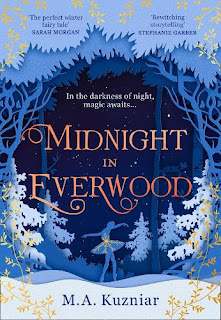
Midnight in Everwood, M. A. Kuzniar

This post contains affiliate links. If you click through and buy I will receive a percentage commission at no extra cost to you.

Nottingham, 1906, Christmas is on its way and with it, the end of Marietta’s dreams of becoming a professional dancer. Ballet is her life, the thing that gives her voice, yet her status-obsessed parents require her to give it up to marry well and live the life of a society wife. When the mysterious Dr. Drosselmeier moves to the neighbourhood he is met with countless invitations, parents falling over themselves to match him with their daughters. It soon becomes clear however that Marietta has caught his eye, and he becomes fixated on possessing her. In an attempt to escape an unhappy fate she finds herself stumbling into Everwood, a magical land that appears to hold wonderful potential. It doesn’t take long for the cracks in this sweet world to begin to appear, and Marietta wonders if she will ever find her way home.


The figure of Drosselmeier is deeply unsettling. He is manipulative and over-confident, invading Marietta’s personal space and lacing their outwardly polite conversations with thinly veiled threats. His behaviour is masked by the charming persona he puts on with the rest of her family, and even Marietta’s beloved brother Frederick dismisses her concerns when she raises them. In the depths of Everwood she continues to be haunted by Drosselmeier, who appears in her nightmares, and at times seems as though he might be there in person. He is a textbook abuser, but has the advantage of magic, making her situation feel all the more helpless.


Marietta lives a stifled life of expectation in her family home, denied the possibility of even expressing her desires. She has an ally in Frederick, who is also forced to deny his true self to fulfil the role demanded of him. Marietta does have moments of disobedience, but once she enters Everwood she becomes increasingly defiant. At times entirely warranted, at others foolhardy and excessively contrary, she can be a slightly frustrating protagonist. We see her grow over the course of the book however, her captivity offering her freedom in other ways. She learns to open herself to others, and to re-evaluate her perceptions of her own privilege. Her experiences in Everwood prove her strength and change the way she views the world and her place within it. 


Everwood itself is richly drawn and decadently described. You can easily picture the lavish balls, smell the sweet scent of the sugared world (and worry at the state of their teeth living off a diet predominantly consisting of sugar), and imagine the gorgeous creations that Marietta, Dellara, and Pirlipata are dressed in as the king’s pets. We see the world as Marietta does, and witness her disillusionment as she discovers the world outside the palace and the suffering inflicted on the many for the benefit of the few.


The tyrant King Gelum displays some uncomfortable similarities to Drosselmeier - a desire to possess at any cost. He delights in the suffering of others and does not think twice about destroying those who cross him. Marietta soon learns the harsh consequences of defiance, but also the power of friendship and the willingness for sacrifice that comes with such fierce bonds. In such an intense environment passions run high and despair and love are intensified. Marietta learns not only of the power of sisterhood, but feels her first flushes of romantic, heartbreaking love.


This is an enjoyable, enchanting read that’s perfect for the festive season. Pedants like me will find the constantly odd sentence structures distracting, as well as Kuzniar’s passing fixations with certain slightly unusual word choices that feel unnatural. Nonetheless, you will be so swept up in the magical world, and keen to find out what happens next that this can be forgiven. Recommended for fans of modern fairy tales, light fantasy, romance, ballet, and cosy winter reads, this book ticks a lot of boxes.


Pick up a copy:

Waterstones

Friday, 12 February 2021

Botanical Curses and Poisons: The Shadow-Lives of Plants, Fez Inkwright

This post contains affiliate links. If you click through and buy I will receive a percentage commission at no extra cost to you.

This post is part of the blog tour for the book. Thanks to Random Things Tours and Liminal 11 for providing me with a free copy of the book in exchange for an honest review.

Inkwright’s second book focuses its attention on the dark side of plants, many of which are commonly found in the wild, and even our kitchens. The book opens with a few thematic chapters that focus on the broad history of plants and their uses. Within these pages we learn about Roman emperors who ingested small doses of poison daily to avoid succumbing to attempted poisonings, plants that try to protect against being eaten with their bitter or spicy taste (which humans happily ignore…), and the general trend of poisonings being associated with women. It’s a brilliant introduction that immediately grabs your interest and gives you a taste of the detail that’s to come.

The rest of the book takes a more encyclopaedic approach with plants arranged alphabetically. Unusually for this type of book, the writing is so engaging you can just as easily read it cover to cover or dip in and out as the mood takes you. Inkwright’s depth of knowledge and research is apparent throughout, revealing not just botanical detail but a broad range of social and political history. She acknowledges her sources in both footnotes and bibliography, so for those whose interest is piqued there’s plenty of further reading to be done.

There are tales of everyday foods that contain deadly secrets, the pips of apples and cherries both contain cyanide, for example. Plants have also played a potentially lethal role in the pursuit of beauty over the years. Cuckoo Pint’s roots were popular as an exfoliant in the medieval period despite its potential to blister and burn the skin. Atropine, found in Deadly Nightshade, was known to be used by medieval Venetian ladies to dilate their pupils. Unfortunately, frequent use could cause it to travel along the optic nerve and cause psychological damage. On the flip side, atropine has been used by opticians prior to surgery and can also be used to treat the ill effects of some other poisons. Inkwright teases out many of these contradictions and highlights the thin line between poison and cure.

She writes also of traditions that give plants a consciousness - basil is believed to belong to the Devil in some countries and thought to only thrive when it is cursed at or hated. Inkwright explores the rituals and beliefs that surround plants, often used in burial rites or to ward off evil spirits, and considers how these beliefs came into being and what characteristics have caused some plants to be associated with the underworld.

This is a visually appealing book, beautifully illustrated throughout and with a striking cover that will make you want to pick it up. You do not need to go in with any botanical knowledge, but you will certainly come out with lots of interesting facts. It will make you look at every day plants with fresh eyes and consider the role they may have played in historic events such as the Salem Witch Trials and even Van Gogh’s distinctive style. Pick up a copy to find out what role plants might have played in these and many more fascinating scenarios.