Showing posts with label debut novel. Show all posts

Wednesday, 17 September 2025

Well, This Is Awkward, Esther Walker

This post contains affiliate links. If you click through and buy I will receive a percentage commission at no extra cost to you.

This post is part of a blog tour. Thank you to Random Things Tours and Bedford Square Publishers for providing me with a copy of the book in exchange for an honest review.


Mairéad lives a busy life in London as the head of an influencer agency, which she recently sold to a large conglomerate, giving her the financial freedom to buy a home and decorate it in her dream style. She’s suffering dating fatigue from being on the apps too long, struggling to feel relevant at work where an increasingly young workforce see her as old, and feels the pressure to constantly be ‘on’ in a world of endless notifications. When her estranged sister Lenny has an accident and is unable to care for her daughter Sunny while she recuperates in hospital, suddenly Mairéad’s carefully curated life feels like it’s falling apart at the seams. Lenny and Sunny live off-grid in a cabin in Wales, believe medicine to be poison, and try to live ferociously eco-consciously. When Sunny arrives in London she struggles with the busy-ness, the noise, the choice, the waste. She just wants to spend her time reading, and eventually bonds with the goats at the zoo and wants to spend every waking moment there. Mairéad is at a loss how to cope. She never wanted children, doesn’t know how to look after them, and just wants her beautiful, clean life to return to normal. She hopes to palm Sunny off on her reclusive, tech-obsessed mother, in a house full of eccentric lodgers, but her conscience soon gets the better of her and she realises that she’s the only one who is going to at least try to take proper care of Sunny.


Due to her financial windfall she is able to take some time out of work when she realises it’s completely untenable to try to do both. A disastrous attempt at taking Sunny to work followed by a failed attempt at recruiting a temporary babysitter open her eyes to just how much time raising a child takes. Sunny is comparatively low-maintenance. She is used to having very little and either wants to have her nose in a book or be communing with whatever animals are nearby. She struggles with busy shops and with social niceties however, making it difficult for Mairéad to do simple tasks like food shopping. We see Mairéad begin to crumble under the pressure, unbelievably bored shackled to her niece, yet with time she realises that she has become quite attached and feels something missing when they are apart. A summer holiday orchestrated by her friend Dodie leads her in contact with many more children and young people and her maternal instincts begin to come alive, although she continues to worry whether she’s doing the right things. She’s impressed by Sunny’s confidence in the water and tries to step out of her comfort zone to meet her halfway. There is no magic moment where everything becomes easy but they work together through the difficulties to find a way of living that works for them. 


We don’t see much of Lenny directly, merely learn about her through her absence, in the small anecdotes Sunny tells, and in the brief encounters at the hospital and back at the cabin. It is clear that Mairéad has had a difficult family life. As a child she felt a bond with her sister, an equal witness to the particularities of their family life, but as she got older and became involved in eco-terrorism they grew apart. Lenny dreamed of living in a commune in Canada but her pregnancy put paid to those hopes as children were not welcome. When she blows up at Mairéad for having taken their late father to chemotherapy treatment their relationship is irreparably damaged and they no longer speak. Her mother Helen makes constant excuses to avoid her, has never seen Mairéad’s flat and never expects to. She pretends to be willing to help with Sunny but when it comes to it she refuses. It’s clear that even as children they had to battle with the lodgers for attention, and since the rise of smart technology Helen is always distracted, putting her phone or laptop before listening to her daughter. This dysfunctional family life adds to Mairéad’s anxieties about being able to care for Sunny, but it’s clear to the reader that although she goes through the struggles that will be familiar to anyone looking after a child, her heart is in the right place and that they’ll be OK. 


The narrative style is relaxed and informal, and you feel so much that you’re seeing events through Mairéad’s eyes that it is somewhat jarring every time she is referred to in the third person, which remains the narrative style throughout. The story felt a little far-fetched, not because of Sunny’s need for a guardian, but because Mairéad is so able to simply drop her life, to move to a cabin in the wilds of Wales and accepts this as her lot. She completely lets Sunny guide their life, not even considering that they could move into a home with modern amenities nearby so as not to remove Sunny from the life and landscape she knows, but to make her own life less difficult. They also seem to come around to each other very quickly, from complete discontent to quiet understanding, and Sunny gets used to the comforts of Mairéad’s life without too much complaint after her initial surprise at this luxurious way of living. Nonetheless, it’s a nice enough read, with characters put in a situation that would feel impossible to resolve in real life. Walker acknowledges this in resisting a happy ever after moment. We see Mairéad grow into her role, albeit with a few bumps along the way, and Sunny begins to consider a life beyond what she was taught to expect by Lenny.


Pick up a copy:

Waterstones


Friday, 2 February 2024

Blog Tour: A Sign of Her Own, Sarah Marsh

This review is part of the blog tour for the novel. Thank you to Random Things Tours and Tinder Press for providing me with a copy of the book in exchange for an honest review.

This post contains affiliate links. If you click through and buy I will receive a percentage commission at no extra cost to you.

Ellen Lark was born hearing but an illness in childhood results in complete hearing loss. Her family develop their own sign language and communicate smoothly, but as she grows older and she must find a way in the world her mother considers her options. Originally she is intended to study at a deaf school where communication will be in sign language, but her grandmother has other ideas and she is forced to an oral school where the aim is to develop the student’s speech to the point where their deafness is unnoticeable. This is as a concession to hearing people rather than as a benefit to the students who find it much easier to communicate in sign. A repeated theme throughout is how difficult relying on lip-reading is and how much is missed. Eventually Ellen comes into contact with Alexander Graham Bell and his Visible Speech, a system where the movement of the mouth and tongue are symbolised so words can be formed without knowing what’s being said. The glaringly obvious problem with this is that it does not aid the person speaking it but merely creates a type of party trick, a way to make hearing people more comfortable. 

This dive into deaf history and the discrimination faced by those who wish to use sign language is the most interesting aspect of the novel, but the plot also focuses on Bell’s attempts to progress his inventions. There is some intrigue with a rival and the suspicion of spying that led to two patents being submitted on the same day. The narrative jumps between Ellen’s youth and several years later when Bell is leading up to demonstrating his new invention - the telephone. The period between the two timelines closes as the story progresses and the technique is not entirely successful. The switch in time is only denoted by the heading of a different city and it can be a little disorienting. I didn’t personally find it added anything to the story to know that things had become fraught later on before we reached it in the earlier narrative, and the closening in time made the jumps even less relevant. A straightforward narrative may have helped build connection to some of the characters, and given them more of an introduction than the slightly confusing structure allows.

Ellen becomes quite taken with Bell when he is teaching her, her youth showing through as she hopes to impress him and hold on to the belief that he shares things with her he doesn’t with his other pupils. He is impressed with her lip-reading abilities and so she is reluctant to admit how ineffective it is. She hates to think that he speaks to her more slowly than he does with hearing people, that he sees her only as a student. In time, she has to accept that his affections lie elsewhere, and ultimately, that he is not a true ally of the deaf community. When she meets Frank, a deaf printmaker who is steadfastly against Visible Speech she sees what life can be surrounded by people who sign. He also confronts her with some difficult truths about Bell who in turn reveals some unfortunate events from Frank’s past. Their relationship is difficult but it’s clear there is genuine affection between them, and it is a stark contrast to her relationship with her fiancé, with whom we see very little desire.

She often feels out of place in both hearing and deaf circles as her signing is not strong due to her oral education, and she comments on how unnatural communication is with hearing people. She misses out on side jokes and chit-chat. It is exhausting constantly trying to understand what is being said around her, and she even writes an essay on homophenes - words where the lip shape matches that of a different word. It really drives home the fact that lip reading can be useful to aid comprehension but is incredibly difficult to rely on entirely. Throughout we see people look on sign language as animalistic, unintelligent and uncouth. It is sad to witness this discrimination and refusal to allow people the ability to communicate in their own language. This is a very real part of deaf history, and one that is only recently being turned around.

This is a beautifully written novel which allows us to see the world through Ellen’s eyes. The descriptions of signs are written in such a way that those who know BSL will recognise them, and those who don’t will easily be able to picture the movements. This is a coming of age novel with Ellen trying to find her voice in a world which tries to silence it. A promising debut.


Friday, 24 November 2023

The Confessions of Frannie Langton, Sara Collins

This post contains affiliate links. If you click through and buy I will receive a percentage commission at no extra cost to you.

Frannie Langton is born into slavery on a plantation ironically named Paradise. There she witnesses extreme cruelty. She learns to read, and as a result is forced to help Langton with his experiments, the horrors of which haunt her throughout. The plantation burns down and she is taken to London where legally she is free but Langton nonetheless gifts her to his rival Mr Benham. We know from the start that she is on trial for the murder of Mr and Mrs Benham and this colours the way we watch their relationship develop. She sees how unhappy Mrs Benham is in her marriage and as they grow closer a physical attraction develops. She is judged by the other servants in the household, and the two of them descend into opium addiction, yet it is a cruel turn of fate orchestrated by Mr Benham that seems likely to push them both over the edge. 

The circumstances of the murder are hazy. Frannie doesn’t remember what happened, and the witnesses pointing fingers are basing their assumptions on circumstantial evidence and prejudice. Frannie’s confessions are her opportunity to give voice to her life. She resents the people who take on the role of white saviours, revelling in hearing tales of suffering, making money from the misery of others. She wants her life to be understood fully, not to be mere entertainment, a way for people to feel better about themselves. Her writing is passionate and engrossing. Her life has undoubtedly been difficult, the people around her treating her terribly, but she is so much more than what has been done to her. 

She is not used to receiving affection. Growing up not knowing who her mother is, after the loss of another slave in the house at Paradise, Langton becomes her closest acquaintance. His experiments aim to prove that people of colour are not human as a way of justifying slavery and ill-treatment. He sees that Frannie is intelligent and in private speaks to her with some degree of respect, but as soon as he is in the company of white men she is treated as invisible. The fact he gifts her to Benham shows that he never really saw her as anything more than a possession he could use to his own advantage. She is left with a feeling of confusion, of temporary sorrow at his exit from her life. The lingering emotion however is guilt, shame at what they did together, an inability to absolve herself of responsibility for the actions she was forced to perform. There is a sense that she is willing to take the blame for a murder she may not have committed as punishment for the evil deeds she’d witnessed and been forced to participate in.

The women in the houses where she lives are unhappy and bored, a very dangerous circumstance for those who serve them. They have no love for their husbands and take steps to try to avoid pregnancy, taking what little control they can. Mrs Benham is forced to perform her role as a good wife and hostess even when she is suffering, and Mr Benham’s attempts to save face descend into cruelty. Frannie sees this and feels for the woman she has come to care for deeply. Their relationship is a difficult one, and far from being equal. When Frannie finds herself alone she realises how little opportunity there is for women of colour to even buy themselves a drink, let alone find work that doesn’t involve satisfying the sexual whims of wealthy men.

Her life is hard and full of suffering, disappointment, and rejection, yet she is defiant. She knows that she is capable and intelligent and will do what she must to survive. Her confessions are powerful. Langton and Benham are fictional characters but their actions reflect experiments that were carried out around this period. A haunting, disturbing book. Well written and with characters that feel real, this is an impressive debut. 

Wednesday, 10 May 2023

If Tomorrow Doesn't Come, Jen St. Jude

 This post contains affiliate links. If you click through and buy I will receive a percentage commission at no extra cost to you.

This post is part of the WriteReads blog tour for the novel. Thank you to The WriteReads and Penguin for providing me with a review copy of the book in exchange for an honest review.


It’s Avery Byrne’s nineteenth birthday, and she is not intending to survive it. Her plans are disrupted when she receives a call from her best friend Cass telling her an asteroid is headed to Earth and they all only have nine days left to live. She soon finds herself battling to get to Cass and get them both back home in Kilkenny, her roommate Aisha and lecturer Dr. Talley in tow. Their presence acts as a point of anxiety for Avery as they both know dark secrets that she desperately wants to hide from her family.

The narrative bounces between the countdown to the end of the world and the history of Avery, revealing her challenges with her sexuality, strictly religious parents, mental health, and keeping up with her classes and sport. In high school she had been a star on the soccer team and a straight A student, but when she arrives at Eaton she struggles to thrive while her mental health makes her very existence unbearable. Her struggles with depression are painfully realistic and it’s heartbreaking to see how little of her light she sees. Convinced her loved ones would be better off without her, and certain there will come a time when she is no longer around, she keeps herself from getting too close to her nephew, not wanting him to become attached to her. The day Avery was born her aunt Devin killed herself, and she sees it almost as an inevitability that she will do the same. She has been told how much she looks like Devin which only reinforces the idea that they have a connection, a shared destiny.

The thought of being stuck in a bunker with her family fills her with dread because she isn’t sure she’d be able to keep the carefully constructed mask in place, that they’d see her completely. Can the last few days before the collision make her want to keep living, make her feel worth the affection of those around her?

If there’s one person who can help her turn things around, it’s Cass. They have been best friends for years but Avery’s secret feelings for her add tension. The last time she saw Cass she told her she hated her, but when it comes to it, there’s nobody either of them would rather be with. Cass has been openly gay for years, she is vibrant, beautiful, and fun, and Avery feels herself pale beside her. You root for them to be together but the flashbacks show how often they’ve miscommunicated their feelings and hurt each other. This isn’t an idealised relationship, it’s very relatable and it has the potential to help Avery feel at home in the world.

The apocalyptic world they are living in is intense. Cities are dangerous, planes are grounded, and suburbs are abandoned. Her brother and sister-in-law, neighbours to her parents, fall apart under the pressure of trying to protect their son from the reality of what is happening. An apocalypse party brings Avery and Cass face-to-face with a spurned classmate who is looking for revenge, and all the normal rules that guide life are broken in this terrifying new world.

This is a deeply emotional read. It is written absorbingly and the characters all feel believable. The emotions and challenges of first love will be relatable both to those reading in the throes of adolescence and those reading with the advantage of age. A compelling read, and one that you might want to keep a box of tissues to hand for. 

Pick up a copy:

Wednesday, 4 May 2022

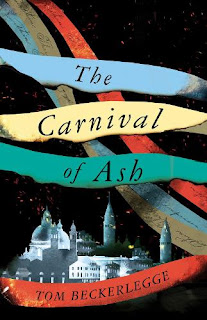
The Carnival of Ash, Tom Beckerlegge

This post contains affiliate links. If you click through and buy I will receive a percentage commission at no extra cost to you.

This post if part of the blog tour for the novel. Thank you to The WriteReads and Rebellion Publishing for providing me with a copy of the book in exchange for an honest review.

Cadenza is a city in turmoil - its leader recently dead and a whole host of intrigue and violence occurring just below the surface. The risk of this instability is heightened by the ever present threat of its rival, Venice. Cadenza is a city of poets, where literary talent is highly valued and there are libraries around every corner. This historic setting might sound idyllic to the booklover who picks up the novel, but it doesn’t take long to realise a respect for and love of literature doesn’t undo the darker parts of human nature.

The book is split into twelve cantos, effectively short stories focussing on different characters. It took a little while to get used to the fact we weren’t coming back to the characters to continue their stories, although some do make guest appearances in other cantos. The stories range from the darkly humorous to the deeply disturbing. We first meet Carlo Mazzoni lying in a grave, an unsympathetic gravedigger quite happy to bury him with the intended inhabitant, but not to dig a new grave. Carlo soon decides against the idea and is encouraged to face his troubles. Other stories contain accounts of horrible mutilations, betrayal, and explore the depths people will sink to in order to gain power.

In one canto we meet Vittoria/Hypatia, an ink maid who spends her days writing letters that fulfil her clients’ fetishes in exchange for money. She has her own desires and painful secrets however, as well as a mysterious stranger who knows far more about her than she can comprehend. Her story shows that even in this alternate history women’s desires are frowned upon and that acting on them is cause for severe punishment. 

There are some truly gruesome descriptions and seemingly depraved characters, with the truth behind the public facade revealed gradually. The sexual and violent content won’t be to everyone’s taste, but if you can stomach those scenes the rest of this chunky book is likely to have something to interest most readers, so varied are the cantos. The world is richly described and you can easily imagine Cadenza to be a real city. I’ll be interested to see what Beckerlegge does next. 


Friday, 7 May 2021

Grown Ups, Marie Aubert (trans. by Rosie Hedger)

This post contains affiliate links. If you click through and buy I will receive a percentage commission at no extra cost to you.

Thanks to Pushkin Press for providing me with a free review copy of the book in exchange for an honest review.

We meet Ida on the way to her family’s cabin to celebrate her mother’s 65th birthday. In the opening sections we see her frustrated by a child on the bus playing with an iPad at full volume, and later interacting with Olea, her sister Marthe’s step-daughter. In these interactions we see how important it is to her that she knows how to behave around children. Marthe is three years into trying to get pregnant and the topic has dominated conversations during that period. Ida, single and 40, has quietly started the process of potentially freezing her eggs, believing that it might be the first step toward the life she wants. The birthday celebrations are overshadowed by the news that Marthe is in the early stages of pregnancy, and the sibling fallout that ensues.

The relationship between Marthe and Ida is fraught with jealousy and misconceptions. Ida finds her sister’s relentless complaints difficult to stomach when she has everything Ida doesn’t. On the other hand, we see that throughout life Ida has generally been considered the more attractive, more successful sibling. Marthe suffers from Crohn’s Disease and her health has often put limits on what she’s able to do. Their mother always prioritised taking care of her, leaving Ida craving the kind of attention and care she sees Marthe receive. There is a sense that her achievements and struggles fell to the wayside while Marthe was coddled and anxiously cared for.

Ida’s behaviour toward her sister is often less than admirable, constantly undermining her with Olea, taking pleasure in problems she caused but which Marthe appears responsible for. She is jealous and spiteful and struggles with the idea of her sister ‘overtaking’ her. She’s so used to consoling her that she’s not sure how to navigate their relationship when things go well for Marthe.

The way Ida is treated by her family is also often far from fair. They sideline her and fail to consider her feelings. When Ida opens up about her attempt to freeze her eggs it is a short conversation and no concessions are made to take into consideration the fact baby talk might be a sensitive subject for her.

Outside of the family circle Ida admits to feeling invisible. Her friends’ lives seem to expand and grow whereas hers remains much the same. She fears that she may have decades of the same ahead of her. Ida may not always come across as likeable but her insecurities are clear, and the way in which society views women of a certain age that aren’t settled down with a family have become internalised. Her desperation for companionship often leads her to make rash decisions and become clingy, choosing men who are unavailable or unwilling to consider a serious relationship with her.

This is a short book but one that manages to capture the essence of a family dynamic that will be familiar to many. All the characters have their imperfections and know how to hurt each other. The short passages showing their past are revealing as to how they became the people they are. We see where their insecurities come from and understand how this feeds into their need for reassurance. They feel very real, as messy and contradictory as anyone you’ll meet in real life. A brilliant examination of a grown-up family that draws on wider societal concerns to add an extra layer to their pre-occupations.

Sunday, 4 April 2021

A Book of Secrets, Kate Morrison

This post contains affiliate links. If you click through and buy I will receive a percentage commission at no extra cost to you.

This post is part of the blog tour for the book. Thanks to Random Things Tours and Jacaranda Books for providing me with a free copy of the book in exchange for an honest review.

Susan Charlewood, born in Guinea (modern day Ghana) as Nsowah, was ripped from her homeland as a small child along with her brother and mother. During the ensuing voyage her brother was tricked and kidnapped in Seville, and so they arrive in England without him, his absence a constant source of distress. They are taken to Sussex to serve a wealthy family, and when her mother dies Susan is raised and cared for at Framfield. When the family begin to disintegrate she is sent to London to marry a printer many years her senior. She soon finds herself embroiled in Catholic plots of rebellion, faced with some difficult decisions.

Susan is a strong, intelligent character. As the book progresses we see her confidence and resolve grow, finding a place for herself in the busy and dangerous city. She feels isolated at first, feeling a distance between herself and those who have been brought to England under similar circumstances, many of whom passed through Spain and Portugal and have an understanding of these languages. She feels herself an outsider, that her skin makes people suspicious of her. At Framfield they had known her from infancy and so loved her for the person they knew. In a city full of strangers she has to overcome initial prejudice to really be seen.

The issue of race is present throughout but is woven subtly into the narrative. Her stoicism cracks at one point and she reveals a glimpse of the frustration she has felt.  ‘And how should you like it, to always be known for the colour of your skin, which is tainted by the things people choose to see in it - the devil, night, carrion birds? Your whiteness is invisible, no-one looks at you and thinks of leprosy, shrouds, ghosts and white-furred mould. I would like, just for a day, to walk around as you do without looks and stares. I would like to be so unremarkable.’ She regrets the outburst but it is a powerful passage to read. When she falls pregnant she is forced to cope with people frequently wondering how dark her baby will be ‘as if we were trying out some new recipe for syllabub rather than making a living person.’, and in a particularly cruel scene her nationality is blamed for the death of a precious child. 

Her sense of identity is also explored. She remembers little to nothing of her homeland, having been removed from it at such a young age. Other characters casually dismiss her sense of kinship but she resists - she may know little of it but her culture remains important to her and her sense of self. It is painful to watch her berate herself because she doesn’t know the language or the meaning of the keepsakes she treasures from her mother. She eagerly seeks more knowledge, a deeper connection with her lost family and the heritage that she’s been denied.

Within the confines of England dangerous tension simmers between Catholics and Protestants. With Elizabeth on the throne, Catholics are forced to practice in secret, risking an agonising death if discovered. Susan and her husband John are heavily involved  in printing Catholic works yet the weight of hypocrisy essential for survival weighs heavily on John. Friends and contributors are caught and punished and he must suffer printing the gory details of their demise. Susan supports his subversive work but there are times when she must question his motives and honesty. In a world of scheming it’s hard to know who to trust and she must bear the burden of impossible decisions.

Her position is diminished by the fact she is a woman, and although at times advantageous as a cover of innocence, is frequently frustrating. She is kept in the dark and dismissed yet sees more than others realise, willing to go to extremes to protect those she loves. ‘I seemed to do nothing but wait and watch. A woman’s place, yes, but should a woman wait and watch as the sea came in until it washed her all away, or should she pick up her feet and run? I felt the tide coming for me.’ Certainly Susan is not content to wait for life to happen to her, setting out on dangerous missions in search of the truth. When a disgraced former confidante re-emerges later in life she displays a worldliness and determination that surprises her adversaries.

This is a stunning debut - evocative and richly descriptive, it will transport you to the chaos of Tudor London. Morrison deals sensitively with themes of loss and grief and reveals a side of history that is often obscured. With a strong female protagonist and villains that will make your blood boil, this is a hard book to put down.

For more information on the research and history that went into the book head over to The Brown Brontë blog for a fascinating interview with the author.


Saturday, 20 February 2021

Bad Habits, Flynn Meaney

This post contains affiliate links. If you click through and buy I will receive a percentage commission at no extra cost to you.

This post is part of the blog tour for the novel. Thanks to The Write Reads and Penguin for providing me with a free copy of the book in exchange for an honest review.

Alex Heck is embarking on her junior year at St. Mary’s Catholic School, a boarding school hundreds of miles from home with some very conservative values. There’s nothing she’d like more than to get herself expelled, her file of misdemeanours already overflowing with reports. Unfortunately for her, her dad is determined she should complete her time there and so she tries to come up with an idea so outrageous they’ll have no choice but to expel her. Putting on a production of The Vagina Monologues with the five other members of The Feminist Club seems like just the ticket, but she will, naturally, come up against a lot of resistance.

Her attempt to put on the play does run throughout the novel but isn’t really the main focus, rather a vehicle to discuss the problems that arise from living such a repressed life. It becomes clear that their sex education is severely lacking, and her sweet roommate Mary Kate can’t bring herself to say the word vagina or buy tampons (her mum posts her a supply). Alex has become the unofficial counsellor to her peers, being the person everyone goes to when they have a problem they can’t discuss with the nuns that watch over them. She may come off as brash and self-centred at times, but the messages about not being ashamed of the female body, and the right to have autonomy over what happens to it are important, and relevant to readers of any age.

Alex starts the novel very deliberately acting out and blowing situations out of proportion to make a point. Her quest for inequality does’t feel genuine but more an excuse to stand out and ruffle some feathers. Her outright dismissal of those who don’t hold the same views as her or who conduct themselves differently can make it harder to like her and undermines her pro-choice stance. However, as the novel progresses and she spends more time around groups she would usually avoid, it becomes clear that the stereotyped view she’s taken of them is often inaccurate. We begin to see the events that lead them to form the opinions they have, and although Alex is reluctant to admit she was wrong, there is some slight concession that other people can have a valuable input in the conversation, even if she still thinks her views are superior.

The boarding school setting is an ever-popular sub-genre of children’s and YA books, and Bad Habits gives it new life. It’s not all midnight feasts and hockey sticks at dawn, Meaney explores the struggle that Alex and some of her peers experience in trying to make sense of why their parents have sent them away. We see in the opening chapters how distant her own parents are and her dad, a St. Mary’s alumnus, refuses to admit what was right for him might not be for his daughter. Later in the book, when her mindset is beginning to shift, we see also how she has struggled splitting her life between California and school, completely separate from her ‘real’ life. The struggle to maintain friendships amid the disorientation of everything that’s changed while she’s been away during term time will be a familiar feeling for anyone who’s ever had to move away from their main support network.

This is an enjoyable read with a serious message amid the madcap schemes of rebellious teenagers and strict school rules. It’s written in such a way that we get Alex’s impressions of the other characters but can also see things that she is blinded to, offering us the opportunity to form our own opinions. The action takes place over only a few months but we see huge growth in many of the characters. That the side characters are also afforded the space to develop makes this a well-rounded read. 

Sunday, 18 August 2019

Sight, Jessie Greengrass


Greengrass’ debut novel is unapologetically introspective as our narrator questions whether or not she should become a mother. Her decision is known from the start and so it is not that you wait to find out but instead experience all the self-doubt and moral questioning that went into the outcome. In some ways her reservations seem linked to the death of her own mother. The dependence and forced physical intimacy toward the end had a profound effect on her and the absence of a maternal figure that follows makes her question herself. Without a mother she forgets how to be a daughter, something she doesn’t notice until she receives the care of her partner’s mother.

Her relationship with her maternal grandmother has also impacted her deeply. Known only as Doctor K, she advocated for an examined life, sitting with the narrator as a child, teaching her to reflect on dreams and her internal life. She encouraged her own daughter similarly, resulting in the extinguishing of dreams, a fact the narrator has always found sad. The novel is interspersed with sections on historic figures. The most obvious parallels are with that of Sigmund and Anna Freud in which the father psychoanalyses his own daughter with seeming beneficial results. Many readers would question the moral reasoning behind a parent exposing their own child to their analysis, and the narrator finds connections to her own moral musings.

Many of the historic sections deal with consent or the lack thereof, and the narrator torments herself with the thought of bringing another person into being without the chance of them having given consent. She feels keenly the responsibility that in choosing to become a mother she must make herself the best than she can, a task she believes she has failed before her baby has even been born, putting her own comfort first. This guilt and self-doubt do not seem to fade with time. She notes that she is only truly able to love in absence – when she is with her daughter she craves time to herself yet when she gets it wishes she were with her. Many of the thoughts and behaviours she chastises herself for appear to be experiences common to parents.

A refreshing, honest look at motherhood in the modern world. In generations past it would be hard to imagine a book such as this being published, for it to be acknowledged that motherhood is not necessarily the obvious choice and that it is just that, a choice. Greengrass creates a sense of place with great skill and the tangents into the lives of real people are both interesting and add depth. An unsettling but thoughtful read that opens the way for considered conversation.