Showing posts with label art. Show all posts

Sunday, 20 February 2022

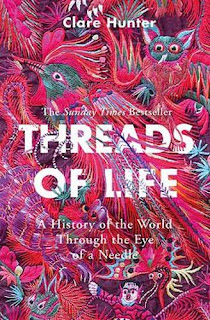
Threads of Life, Clare Hunter

This post contains affiliate links. If you click through and buy I will receive a percentage commission at no extra cost to you.

Hunter’s brilliantly informative and emotive look at the history of embroidery from the Bayeux Tapestry to the present day is the perfect mix of personal memoir and wider history. She considers the rise and fall of respect for the craft, the ways it has been used to comfort, strengthen, and protest, and the curatorial decisions that obscure so many great creatives. Arranged thematically, each chapter could be read in isolation, but the experience of reading cover to cover offers insight and a sense of the patterns of time.

We start with the Bayeux Tapestry, which is an example of many of these themes. Over the centuries it has been through many levels of popularity and respect. It has been dismissed at times as a piece of amateur work and criticised for its inconsistencies of style, at others it has been carefully saved during times of conflict. Always, however, the women who created it seem to have been ignored. Indeed, its incorrect designation as as a tapestry rather than an embroidery can be seen as an attempt to separate it from women’s work. Its content focusses almost exclusively on men, with only six women appearing, and even today, visiting as a tourist, its exhibition leaves out any mention of its creators. 

This is a sad occurrence which we see repeated time and again. Women were excluded from the London Guild of Broderers after the Black Death in an attempt to preserve the reduced number of commissions for men. This succeeded in de-professionalising the skilled women who worked in the field and relegated projects that came their way to much smaller, more menial work. When the sumptuary laws were revoked in 1630 embroidery was no longer considered a high art, losing its status as a symbol of wealth and power. This led men to draw away from it and to further divide men’s and women’s work, which became increasingly associated with family care and its virtues.

Embroidery enjoyed something of a revival in the eighteenth century with the popularity of thread painting. Despite some women succeeding in making a living out of it, very little of their work has survived. This is, unfortunately, a recurring pattern. The use of banners by suffragettes was an important part of their demonstrations yet when offered to Scotland’s museums they were rejected as having no historical value. Indeed, the National Museums of Scotland have only one stitched suffrage banner on display - for the Federation of Male Suffrage. Similarly, examples of embroidery by Mary, Queen of Scots, stitching at a time when embroidery was rich with hidden meaning and a symbol of status, are few and far between.

Embroidery has been used throughout history to create a sense of unity. Hunter’s work as a community textile artist has shown time and time again the value of creative expression and its power to bring fraught communities together. It helps to empower participants and gives them a sense of ownership over their story. This can also be seen in the moving examples detailed of its use in the most dire situations. Women in Changi Prison created quilts as an act of resistance and communication masked as a feminine act of care. During war it has often been used to record experiences and help to maintain a sense of self when attacked on all fronts.

This book is rich in historical detail and offers insight into beliefs around created pieces such as the spiritual power of joining fabric together, which was the traditional appeal of patchwork - resurrection, reconstitution, and re-connection. You learn not just about the role of sewing in social and political movements but of the events surrounding them. A trigger warning of torture and sexual violence for some sections. I wasn’t expecting a history of embroidery to be so emotional, but there are many moments throughout that will make your heart ache. An homage to an often-undervalued art, beautifully written and utterly compelling.

Thursday, 30 April 2020

Van Gogh: The Life, Steven Naifeh and Gregory White Smith


Vincent van Gogh is today one of the world’s most beloved artists. His distinctive style is instantly recognizable and the legend that has built up around his life and death promote the idea of him as a tortured genius. This epic biography paints a more balanced picture, focusing not just on the final few dramatic years of his life in which he painted many of his most iconic pictures. Instead, the reader is taken through a detailed account of his whole life – his struggles and failures, obsessions and hopes. At times it is difficult to read the harsh realities of a troubled life.

From his early years he longed for close familial relations, something that remained largely absent throughout his life. His strained relationship with his parents and the circumstances around his father’s death meant an icy reception for their wayward son. His brother Theo often took the role of peacemaker. His relationship with Theo was arguably the most significant of his life but was also fraught with difficulty. Theo financially supported his brother for most of his adult life and suffered social exclusion when he came to live with him in Paris. Vincent seems to have swung between a sense of entitlement and deep feelings of guilt for the burden he knew he was to his brother. The passages describing some of their interactions show behaviour that is nothing short of abusive and is incredibly hard to read. Despite their difficulties, Theo continued to champion Vincent and hope for success in his endeavours.

Vincent emerges as unlikable at times but often as childishly innocent, longing for acceptance and a family home. He travelled around a fair amount and would dream of Theo joining him. His preparations of the Yellow House for Gauguin’s arrival are endearing but the reader is left with a sense of dread knowing his hopes will once more be dashed with disappointment.

He was an outcast wherever he went, people finding his intense painting style alarming and his disheveled appearance a point of mockery. It is this rejection by society that defined his life. He enrolled in art school on a number of occasions but inevitably dropped out due to his unwillingness or inability to follow instruction. His first taste of potential success appeared mere months before his death thanks to the championing of Albert Aurier, a young art critic, but he was sadly not well enough to enjoy it.

Naifeh and Smith rarely speculate throughout, relying on documentary evidence to trace the tumultuous life of Van Gogh. They do not attempt to diagnosis his ailments but merely report on his medical record, explaining the context and medical developments that were happening at the time of his treatment. One point on which they do object however, is the myth of his untimely death. In an appendix that details the evidence that led to their conclusion and the flaws in sources for the alternative, they offer a reasoned debate. This part of the book did not go down well with many in the art world however, and they were accused of having included it purely for the publicity it inevitably created around publication.

A comprehensive, well researched biography that is easy to read thanks to its lively and smooth prose. The wider artistic and cultural conditions of the day are brought to life, situating Van Gogh very much in his time. If you want to know more about the man behind the legend then this is a great place to start.

Further resources can be found at http://vangoghbiography.com/ and scans and transcripts of Van Gogh’s letters can be viewed on http://vangoghletters.org/vg/

Tuesday, 31 December 2019

2019 in review

Another year draws to a close, and another challenging one for the planet. In a world gone mad it can feel as though the book blogging community is a little bubble of calm and positivity that I’m happy to be a part of. Thanks to the Two Amy’s Bookclub in the first half of the year (it’s sadly now been disbanded), I read a few more current books and some I wouldn’t have come cross otherwise – Bear Town I’m looking at you. Some other highlights were Normal People and The Binding. All very different books but ones that caught me up in their world, make me think, and dealt with serious issues in interesting and unique ways.

It’s been a year of some fantastic fiction including Autumn by Ali Smith, a humourous and thoughtful examination of the world we live in and the importance of relationships in making sense of it. The Blind Assassin although long, swept me along and I was left wanting more. My Brilliant Friend by Elena Ferrante is a powerful start to a quartet, the rest of which are on my to be read pile for 2020.

I started the year with the intention of alternating between fiction and non-fiction and although I didn’t quite manage a 50/50 split, I did read some amazing, interesting, and challenging books such as James Bloodworth’s Hired: Undercover in Low-Wage Britain and Why Grow Up? by Susan Neiman, both books that sparked a lot of discussions and that I continue to refer back to.

I was lucky to spend some time this year working in a public library and it was a great reminder of what a precious resource they are. Yes, it’s wonderful that they give access to all to a huge array of books for free but they are also so much more. I was surprised by the amount of regulars who came in to read the papers, use the computers, do their homework, or simply to interact with others. I’ve always felt joy when visiting libraries but have a new appreciation for the myriad of services they provide and a deep sadness at their dwindling numbers.

Sticking to the theme of free public resources, I came across this syllabus for a DIY MA in Creative Writing which I have begun working my way through. I admit however that I’ve made more progress with Tim Clare’s Couch to 80k podcast as each episode is only around twenty minutes and this feels a manageable chunk of time to commit almost every day. Spurred on by the thought of being able to study on your own terms I’ve undertaken to do similarly with Victorian Studies, a subject I’ve been longing to study further for the past decade. Accepting that it’s unlikely to ever be practical to go back to University, I am contenting myself with self-study and although I will of course miss out on lectures and seminars, I will enjoy having the luxury of time to spend as long as I want on each topic, reading widely.

Theatre visits have been few and far between but I was lucky enough to catch Notre Dame de Paris when it was in London at the start of the year and Rosmersholm in summer. 2020 is already looking promising with a number of tickets already organised, including a trip to Leeds for Northern Ballet’s 50th anniversary gala and English National Ballet’s 70th anniversary gala in London in the same month. What a treat of groundbreaking dance they will undoubtedly be. I’ll also being seeing out this year with the Royal Ballet performing Coppelia, a pretty, lighthearted production.


There have been some brilliant exhibition and museum visits this year including a trip to the William Morris Gallery and the Pre-Raphaelite Sisters at the National Portrait Galley (which there’s still time to see). They made me appreciate the pleasure of seeing famous paintings in real life, for example, Millais’ Ophelia which has never been a favourite, is utterly luminous in reality. The new galleries at Westminster Abbey are stunningly beautiful and designed sympathetically to their surroundings. Further afield it was a joy to be able to visit Hill Top, one of Beatrix Potter’s houses in the Lake District. At her request it has been preserved as she left it. The Villa Medici in Rome is a trip I’d definitely recommend and the Vatican, for all that it is undoubtedly impressive, made me appreciate smaller, more manageable galleries where you have the time and space to really appreciate the art.

I’m looking forward to another year full of books, theatre, art and travel and hope that yours is filled with all the things that make your heart happy.

Thursday, 27 June 2019

Van Gogh and Britain, Tate Modern


The Tate’s much anticipated Van Gogh exhibition showcases some beautiful work but falls into a familiar trap, trying to put Britain at the heart of great artists’ work. He spent almost three years in Britain before he had begun experimenting in paint, and although he may have been inspired by popular novels of the time and art by the likes of Doré that were inspired by the dark, dirty, crowded capital, the connection to Van Gogh’s signature vibrant paintings is stretched beyond reason.

It was a pleasure to see some of his earlier, darker works and the progression to his distinct style and remarkable use of colour. For years he had obsessed over painting working class subjects in mining villages and elsewhere. He walked remarkably long distances and often chose to live close to destitution. You won’t see much of his difficult, obsessive personal life in this exhibition however, where a concerted effort seems to have been made to avoid bringing in too many biographical details.

Starry Night Over the Rhone, lent by the Musée d’Orsay, is luminous, a painting one could happily stare at for hours, reproductions do not do it justice. Aside from the showstoppers lent by other museums and galleries there are also some beautiful examples from private collections. Although the main focus is Van Gogh there are many works displayed from other artists, Millais’ Chill October being a standout.

An interesting exhibition albeit with some areas that feel like filler content. The Tate has attempted to show how Van Gogh was inspired by Britain and then goes full circle by demonstrating his influence on British artists that followed. The framing may be weak but it is nonetheless worth it to experience the mesmerizing effect his works have on viewers.

Van Gogh and Britain is at the Tate Britain until 11th August 2019.

Wednesday, 7 November 2018

Paris Part One – Montmartre, Atelier des Lumières, and Pere Lachaise Cemetery

Clos Montmartre
Every October Montmartre hosts a festival celebrating the harvest of grapes from its one remaining vineyard. We were lucky that our visit coincided with this annual event as we were able to join a guided tour of the Clos Montmartre, closed to the public at other times of the year. There was a more formal celebration occurring at the same time with robed figures, members of the wine brotherhood of Montmartre as far as I could work out. The vineyard is small and not as historic as some may have you believe. Although vineyards were first introduced to Paris by the Romans and continued to thrive for many generations since, by the end of the nineteenth century they had vanished from the city. The Clos Montmartre was planted in 1933 to rekindle some of the area’s heritage.

After the tour we made our way uphill to the main festival site in front of the Sacré-Coeur. Here we found a bustling street food market selling a wide range of French specialities. The wine yield from the vineyard is auctioned off with proceeds going to charity. Local artists design the labels. Historically an area that attracted artists – Monet, Renoir, and Degas to name but a few, creativity is still evident as you walk the streets, and this custom pays homage to this. Montmartre retains its village feel and remains one of the most beautiful areas of Paris.

L'Atelier des Lumieres
We couldn’t linger too long however as we had tickets for the Atelier des Lumières. A nineteenth century foundry in the 11th arondissement houses an immersive art exhibition. Their first display predominantly features work by Gustave Klimt, as well as some photography from the period and works by Hundertwasser, whose work was new to me. A playlist accompanies the experience as images are projected across the walls, floors and ceiling. Accused by some of pandering to the Instagram generation, it is nonetheless a unique experience. By no means a replacement for seeing the originals, instead it feels not like experiencing them so much as witnessing new art in this carefully curated space, and is well worth a visit.

Pere Lachaise Cemetery
Conveniently nearby sits sprawling Pere Lachaise cemetery. Established in 1804 by Napoleon I, it is the final resting place of many a famous name and is the most visited cemetery in the world. Rows of ornate tombs line paths that spread as far as the eye can see. It feels almost to be a city in its own right. Home to tributes to wars and mass killings, it is hard to imagine that this peaceful, emotive place was once the site of a massacre itself.

Wednesday, 18 April 2018

Impressionists in London: French Artists in Exile, 1870-1904

The Tate Britain's current offering has suffered a lot of criticism for its misleading title. It is true that a lot of the work displayed is not Impressionist and perhaps they have wavered somewhat on the aim of the exhibition. That being said, as one with much still to learn, I thoroughly enjoyed it. 

It opens with a room explaining the devastation in Paris due to the Franco-Prussian war with some heart-rending paintings by Doré (whose Soeur de la Charité is captivating) and a handful of photographs to show some of the war damage. Its aim is to explain how many of the artists featured came to be in London in the first place, and the stark contrast of circumstances in the two capital cities at the time, a recurrent comparison. It's true that many of the paintings included were created later, on holiday or business trips, but it is nonetheless useful to be reminded of the historical context that must surely have left a lasting impression.

James Tissot has a room to himself showcasing his society paintings followed by Alphonse Legros and Jean-Baptiste Carpeaux, whose works are not breathtaking, the sculpture shining brighter than the paintings. 

Pissarro and Sisley's sunny, peaceful depictions of the suburbs are a far cry from the fog-laden paintings that are still to come. They ignore the bustle of the inner city and focus instead on the idyllic rural outer reaches. This is the point at which the Impressionists begin to take centre stage.

The two penultimate rooms are atmospheric and have some utterly entrancing paintings. Monet's Leicester Square can be appreciated at length, drawing out the many layers. de Nittis and Whistler (whose inclusion is welcome but again not strictly within the remit as he is not a French emigré artist) help focus attention on the Thames with their interesting renderings focused on light and fog. Finally, visitors are treated to a group of Monet's famous Palace of Westminster paintings. It's wonderful to see them together and to be able to reflect on the subtle differences.

An interesting exhibition that strays far from its supposed intent but brings out works by lesser known artists to be enjoyed alongside the masters. I certainly left feeling that I'd learned something and experienced some truly magnificent art. If you are an Impressionist enthusiast you may leave disappointed but for the general art lover it is worth a visit.