Monday, 18 April 2022

Dark Emu: Aboriginal Australia and the Birth of Agriculture, Bruce Pascoe

This post contains affiliate links. If you click through and buy I will receive a percentage commission at no extra cost to you.

Pascoe’s divisive re-assessment of pre-contact Aboriginal lifestyles looks at the ways in which they worked the land, and the horrifying deterioration of once prosperous land after the European colonists arrived. His source material largely derives from journals and reports by the colonists. These naturally contain a lot of bias, but Pascoe believes if we look beyond the colonial gaze we can see evidence of sophisticated agricultural systems. 

He writes of the evidence of harvesting practice and the storing of excess food. The colonists commented on the apparent presence of land that had been ploughed and rolled, with evidence of the tools that were used for the task. The farming of kangaroos is touched upon, alongside discussion of the sustainable way the land and animals were farmed. Pascoe speaks about the many examples of tools and other crafted items, such as clothes, rarely being displayed in museums, and the incorrect labels that are attached to them when they are. It seems that the prejudices of the past have filtered down to today, blinding us to the achievements of the Aboriginal people before the first colonists arrived.

His narrative is a painful reminder of the horrendous acts of those who went to Australia and claimed the land as their own, killing and destroying with seemingly no thought as to the lives they were taking and displacing. Indeed, Pascoe claims that one of the reasons there’s so little evidence of the villages and agricultural systems is that the destruction was so swift and complete that by the time the settlers arrived there was nothing left to suggest to them that a prosperous society existed before their arrival. 

Pascoe discusses the farming practices the Europeans brought to Australia which damaged the soil and made it far less productive. They did not try to learn from the Aboriginal people but instead attempted to replicate the type of farming they were used to. Pascoe believes this to have lasting implications for the Australian economy and its food production. Many native plants all but went extinct under the strain of these foreign farming techniques. Settlers were also reluctant to burn land as part of its management, which Pascoe argues has contributed to the prevalence of damaging wild bush fires today.

It is a convincing argument, and one that makes the reader re-consider the snippets of information we are taught about the Aboriginal people. However, it has received a lot of pushback, most notably in Peter Sutton and Keryn Walshe’s Farmers or Hunter-Gatherers? The Dark Emu Debate in which they argue that being a hunter-gatherer is not something to be looked down upon. Hunter-gatherers do not wander the landscape aimlessly but rather know which areas provide what they need at different times of the year, travelling accordingly. They believe Pascoe’s argument attempts to make the Aboriginal people appear more European, which is not a positive strategy for re-assessing a difficult history. They take issue with his focus on colonial sources and lack of interaction with knowledge keepers in Aboriginal communities. Not only could the sources be more diverse, but they also point to a number of examples where he doesn’t include full quotes, ignoring passages that don’t fit neatly with his narrative.

This is a thoroughly fascinating and accessible read that encourages the reader to consider their assumptions. It discusses the ways in which Western ideas of civilisation have been perpetuated to excuse past actions around the world, giving us food for thought on the lens through which we form our opinions. Worth reading, but equally valuable to look into the counter-arguments and problems with Pascoe’s approach.

Saturday, 9 April 2022

The Versions of Us, Laura Barnett

This post contains affiliate links. If you click through and buy I will receive a percentage commission at no extra cost to you.

Autumn in Cambridge, 1958, and a little dog is about have a big impact on Eva’s life. Innocently cycling to meet her boyfriend David, the dog variously causes her to fall off, get a puncture, or cycle on as planned. Jim happens to be walking by and offers help in two of the versions. Neither of their lives will ever be quite the same again. What follows is three versions of their lives, spanning almost sixty years, with all the ups and downs that a life contains.

Eva is an aspiring author, Jim a painter, and David an actor. We see their varying degrees of success and the impact it has on their relationships. How creatively successful can you be while committing fully to a relationship? Can both parties be permitted the freedom to achieve simultaneously, or must one always be sacrificed for the elevation of the other? These are questions that are explored in the book alongside a certain sense of fate - no matter the circumstances some things never change.

Jim’s father was an artist and Jim lives in the shadow of his fame. He cheated on Jim’s mother, Vivian, and there’s also a sense of trying to go against the grain of his genes. Unfortunately, many versions of their lives and relationships include infidelity. This is a book that shows the realities of long-term relationships - the mundanity and expectations, as well as the more dramatic moments. If you’re looking for a happy, rose tinted romance this may not be the one for you.

Eva is fairly consistent in all versions. Accomplished and caring, she does at times allow her partner’s desires and ambition to overshadow her own. She proves herself loyal and with a strong moral compass time and again, but is not without her moments of weakness. David, on the other hand, rarely comes off well. Self-obsessed and vain, he fulfils his father-in-law’s fear that he will never love Eva as much as he loves himself. He has his moments however, and is not a spiteful character. He is destined to be a secondary character to the love between Eva and Jim. Their lives seem to be drawn together, even when they know each other only distantly, there is a fascination there. There is a sense that they are meant to be together, whatever flaws the relationship might reveal in them.

The story's structure is interesting, and although it has the potential to be somewhat confusing it is largely possibly to keep track of each of the versions (although this becomes more difficult as relationships break down and start up, the same characters populating each version). There are little moments that stay the same in each, but with drastically different consequences in the varying circumstances. This felt like a nice touch, and highlights the many moments where our lives have the opportunity to diverge.

Of the side characters, Vivian is the one that is most memorable. With a mental illness that weighs on Jim’s conscience, and a strong desire for him to avoid following in his father’s footsteps, she is a strong, controlling force in his life. Eva’s parents are kind and attentive, and as a result blend more easily into the background. The passing of the older generation is sensitively and powerfully handled.

The scale of the novel means that there’s bound to be an age or circumstance that particularly resonates with readers of all ages. Whether reflective of your life or not, it is quite unputdownable and will leave you constantly wanting to read on. There are moments of great joy and others of bitter heartbreak. Characters will betray those most devoted to them and sabotage their own happiness, yet at the centre is the constant connection between Eva and Jim. At times frustratingly oblivious or stubborn, you root for them through thick and thin. A book that will make you laugh and cry, absolutely worth your time.

Wednesday, 16 March 2022

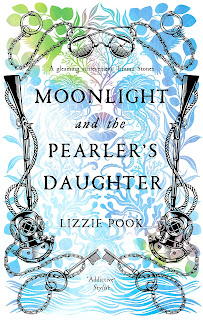
Moonlight and the Pearler’s Daughter, Lizzie Pook

This post contains affiliate links. If you click through and buy I will receive a percentage commission at no extra cost to you.

This post is part of the blog tour for the book. Thank you to Mantle and Random Things Tours for providing me with a copy of the book in exchange for an honest review.

The year is 1886 and the Brightwell family arrive in Bannin Bay, Western Australia, from England. Eliza remarks on the harshness of the land and how very different it is to anything she’s ever experienced before. Her father becomes a successful pearler and the family financially secure. Ten years later however, and we meet Eliza again, alone and waiting for her father to return from an expedition. Instead, she receives news of his disappearance. Before long Balarri, a local Aboriginal man, is arrested for his murder and the police are keen to close the case. Eliza is convinced they are wrong, both about her father being dead, and about Balarri being involved in his disappearance. She is determined to find the truth, and hopes desperately to be reunited with her father. 

The action moves along swiftly in the novel, hooking you in early on. So much happens in the book - tales of grief, shipwreck, drug addiction, and elicit affairs, and yet somehow they pass over you without any lasting effect. The moment of revelation or peril at times captures your heart yet the story moves on at such a pace that there’s no time to absorb what you’ve just read before the next misadventure is in full swing. Many readers might enjoy this fast pace but for me it left me feeling detached from the action and made it a book that was easy to put down. 

The writing, however, is beautifully constructed, with vivid descriptions of the landscape that make you feel as though you’re there. Pook is certainly a fan of similes and at times they feel a little repetitive, but there are also many moments of searing reality in her descriptive choices. 

Pook discusses many topics including the role of women, especially one alone in a dangerous place at a time when women were restricted by their gender. Eliza is headstrong and courageous to a fault, but she reluctantly admits that she needs a male companion to allow her access to certain areas. Axel is a willing companion, and although his presence may be necessary it is Eliza who leads the way and makes some reckless, dangerous decisions. Along the way she meets other women making their own way, at times attempting to live the life of a man. Again, this is passed over so quickly that it barely felt worth including. Alongside the struggles of women is the even more dangerous position of the Aboriginal people. We see from an early stage in the book how they are mistreated and considered guilty without any evidence. Later in Eliza’s travels she witnesses even more so the mistreatment of the original inhabitants of the land and it makes her reflect on her own position there, on the land her family’s bungalow sits on.

Another major theme throughout is family and grief. Eliza has suffered many losses in her young life, and the further disintegration that threatens her family throughout is almost too much to bear. There are moments of real trauma in the flashbacks to the loss of her mother, of the grief of her father and how Eliza experienced the events as a child. This helps to explain her determination to find her father, her need to see for herself what has happened to him. 

This is an interesting, if sometimes predictable read. It feels at times like it’s working to a formula with very familiar story arcs. The conclusion was a surprise, but the characters involved hadn’t made enough of an impression earlier to leave much of an emotional blow. There are short passages interspersed throughout the main text of Brightwell’s diary and an account of someone on the run that keep you guessing how they’re going to interact with the main plot. If you enjoy a mystery with a strong female lead and a brilliant sense of place then this is the book for you.

Pick up a copy:
Bookshop
Foyles
Waterstones


Tuesday, 1 March 2022

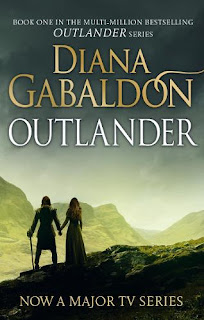
Outlander, Diana Gabaldon

This post contains affiliate links. If you click through and buy I will receive a percentage commission at no extra cost to you.

It’s 1946 and Claire Randall is in Inverness with her husband Frank, reconnecting after a long separation due to the Second World War. Their days are filled with exploring the Scottish Highlands, Frank’s genealogical research, and time getting re-acquainted with each other. One day, however, Claire returns to a circle of standing stones they’d come across on one of their outings and before she knows it she’s passed through one of them and landed in 1743. Here she meets Black Jack Randall, one of her husband’s ancestors, but without any of the gentleness of his descendant. She’s soon whisked away by a group of Highlanders and becomes their captive while they try to work out if she’s an English spy, or threat in another way. During this time she desperately tries to find a way to escape and get back to the stones and Frank. It soon becomes apparent that this will be no easy feat, and that there are many barriers between her and the stones, not least her own heart.

She is naturally disoriented and confused when she first arrives, not understanding what has happened. Once she’s accepted that she has travelled through time she keeps it together as much as possible, but it’s not easy. She is distraught to have been separated from Frank and desperately worried about how he will be coping with her mysterious disappearance. Her medical ability and the openness of the Highlanders to let her heal them helps to ground her, reminding her that these are real people, and giving her a sense of herself. She is not mistreated but she is nonetheless a prisoner, and one that is approached with suspicion. She uses techniques that Frank has told her about from his experiences during the war - when under interrogation to tell the truth as far as possible. His interest in history also proves useful as it provides Claire not just with information that helps her fit in to the time more easily, but also some privileged knowledge which she is able to use as a bargaining tool. Of course, there’s also the difficult position of knowing how history is going to pan out without being able to help change it.

Despite her knowledge there are still many times when her modern views put her and others in danger. Her use of language is frequently in contrast to other women of the time, but it is her inability to stomach some of the cruelties and injustices of the time which cause the most problems. Her response to witnessing physical punishments remind us that although we know about these things happening in the past it is an entirely different experience witnessing them first hand. She also reflects on her own time, on the blame placed on normal German citizens, and how unfair this is when faced with a mob. She is ashamed to discover that self preservation kicks in ahead of saving others.

Luckily for Claire, Jamie Fraser, the hero of the series, is frequently on hand to help not just her, but others in a sticky situation. There are times, however, when he becomes frustrated with Claire, as the reader does, for constantly ignoring those who know the time better, and putting others at great risk as a result. Claire is by no means a damsel in distress, more than willing to stick up for herself, and indeed to kill, but Jamie is often needed to save the day in the typical heroic fashion. At times you’ll find yourself rolling your eyes at how deeply embedded certain topes are, but this does not take away from the enjoyment of the story.

Jamie’s initial introduction, however, is understated - he is a regular Highlander, injured and unassuming. His thoughtfulness and care are built up over time as Claire sees more of his interactions with others, as well as developing an easy rapport with him herself. She feels safe with him, and he promises from the off to protect her. He is clearly a moral man who cares about others, but it is their wedding that will make the reader fall for him. It is a marriage of convenience but he looks after the little details to try and make it special for her. His innocence on their wedding night is endearing and a nice inversion of what we have come to expect from such stories. Criticism has sometimes been directed at the series for the anachronistic modernism of Jamie’s character, but in this first book we see some less appealing aspects that would be more in keeping with the time. He strongly believes in her duty to obey him, a fact that Claire pushes back against. He also beats her as punishment for disobeying, and there are some sex scenes between them which feel uncomfortably close to assault. Even at gentler times she acknowledges that saying no is not an option. 

Despite certain misgivings, both Claire and the reader feel fondly toward Jamie, and as they grow closer she becomes consumed with guilt. She can’t reconcile having married another man, but also feels the cruelty of planning to leave Jamie, who is clearly quite infatuated with her, without warning or explanation. When she finally has the chance to leave she must make a heartbreaking decision as to which man she can’t live without. This is a pivotal, emotional moment, and one that demonstrates the depth of feeling that has developed between the newlyweds.

This is an enjoyable, addictive read. There are many moments of humour throughout and a wonderful host of characters. Gabaldon is careful to remind the reader of Frank when they’re at risk of getting too swept up in the love story of Claire and Jamie. Black Jack Randall provides an unwelcome reminder of her first husband - she often comments on their similarities and the expressions that in one evokes love and in the other horror. This is a clever addition and makes you wonder if Claire would be able to put the memory of him to one side if she were able to get back to Frank. This book should come with a trigger warning for sexual assault as it is alluded to throughout and described in realistic, upsetting detail. At times it feels as though the threat of rape is exaggerated, with all the men seemingly a danger after a few drinks, but the most disturbing incident is dealt with well. It does not feel gratuitous and the emotional consequences are considered quite deeply. 

The book doesn’t shy away from difficult events, and although Gabaldon admits to the history knowingly being incorrect at times, it doesn’t cause a block for readers. There are some sections that drag a little but mostly it is hard to put down. There is love, heartbreak, peril and adventure that will be plenty to keep most readers entertained. If you enjoy books that stir up the emotions this is certainly one for you, and the good news is there’s another eight books to enjoy after this one.

Sunday, 20 February 2022

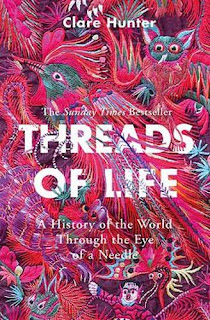
Threads of Life, Clare Hunter

This post contains affiliate links. If you click through and buy I will receive a percentage commission at no extra cost to you.

Hunter’s brilliantly informative and emotive look at the history of embroidery from the Bayeux Tapestry to the present day is the perfect mix of personal memoir and wider history. She considers the rise and fall of respect for the craft, the ways it has been used to comfort, strengthen, and protest, and the curatorial decisions that obscure so many great creatives. Arranged thematically, each chapter could be read in isolation, but the experience of reading cover to cover offers insight and a sense of the patterns of time.

We start with the Bayeux Tapestry, which is an example of many of these themes. Over the centuries it has been through many levels of popularity and respect. It has been dismissed at times as a piece of amateur work and criticised for its inconsistencies of style, at others it has been carefully saved during times of conflict. Always, however, the women who created it seem to have been ignored. Indeed, its incorrect designation as as a tapestry rather than an embroidery can be seen as an attempt to separate it from women’s work. Its content focusses almost exclusively on men, with only six women appearing, and even today, visiting as a tourist, its exhibition leaves out any mention of its creators. 

This is a sad occurrence which we see repeated time and again. Women were excluded from the London Guild of Broderers after the Black Death in an attempt to preserve the reduced number of commissions for men. This succeeded in de-professionalising the skilled women who worked in the field and relegated projects that came their way to much smaller, more menial work. When the sumptuary laws were revoked in 1630 embroidery was no longer considered a high art, losing its status as a symbol of wealth and power. This led men to draw away from it and to further divide men’s and women’s work, which became increasingly associated with family care and its virtues.

Embroidery enjoyed something of a revival in the eighteenth century with the popularity of thread painting. Despite some women succeeding in making a living out of it, very little of their work has survived. This is, unfortunately, a recurring pattern. The use of banners by suffragettes was an important part of their demonstrations yet when offered to Scotland’s museums they were rejected as having no historical value. Indeed, the National Museums of Scotland have only one stitched suffrage banner on display - for the Federation of Male Suffrage. Similarly, examples of embroidery by Mary, Queen of Scots, stitching at a time when embroidery was rich with hidden meaning and a symbol of status, are few and far between.

Embroidery has been used throughout history to create a sense of unity. Hunter’s work as a community textile artist has shown time and time again the value of creative expression and its power to bring fraught communities together. It helps to empower participants and gives them a sense of ownership over their story. This can also be seen in the moving examples detailed of its use in the most dire situations. Women in Changi Prison created quilts as an act of resistance and communication masked as a feminine act of care. During war it has often been used to record experiences and help to maintain a sense of self when attacked on all fronts.

This book is rich in historical detail and offers insight into beliefs around created pieces such as the spiritual power of joining fabric together, which was the traditional appeal of patchwork - resurrection, reconstitution, and re-connection. You learn not just about the role of sewing in social and political movements but of the events surrounding them. A trigger warning of torture and sexual violence for some sections. I wasn’t expecting a history of embroidery to be so emotional, but there are many moments throughout that will make your heart ache. An homage to an often-undervalued art, beautifully written and utterly compelling.

Sunday, 13 February 2022

The Dizzy Cook, Alicia Wolf

This post contains affiliate links. If you click through and buy I will receive a percentage commission at no extra cost to you.

Being diagnosed with vestibular migraine has been an emotional, challenging journey. Preferable, however, to having no answers as to why you can’t tolerate any movement without feeling like you’re going to throw up, having the feeling of being on a boat while lying in bed, or being so fatigued you need a rest after something as simple as having a shower. As an illness that’s only been recognised as a distinct form of migraine in the last few decades it can sometimes feel like there’s a real lack of information and expertise out there. You can imagine then, my delight when I stumbled across Alicia Wolf thanks to another blogger (apologies that I don’t now know who).

In her book The Dizzy Cook, she writes generously about how the Heal Your Headache diet helped her get her life back after being diagnosed with vestibular migraine. It is emotional reading about her experiences, which included losing her job, and the list of foods that you have to cut out is intimidating, especially as a vegetarian suddenly unable to eat lentils, soya, and nuts. However, Wolf completely understands what it’s like to be starting this journey, encouraging you to focus more on what you CAN eat than what you can’t, and offering tips and tricks to make the process easier. She also writes about other parts of the treatment pie and how finding the right combination can help you begin to have more good days than bad. 

It’s a well-thought out book with everything from breakfast, dinner, mocktails, condiments, and ideas for entertaining. There’s also a solid baking section at the end which will please readers with a sweet tooth. Following this diet you quickly realise pre-prepared food that’s safe is almost impossible to find, and you’ll need to make most things from scratch yourself. The variety of sauce and dressing recipes included help you not miss firm favourites, and she offers great ideas for substitutes which help keep a few old popular recipes in rotation with a few adjustments.

Being American based there are quite a few things that are difficult or impossible to get in the UK, but after the initial investment in getting some different kitchen staples it becomes much easier. When I first bought the book I was a bit worried by the small number of vegetarian recipes, but I soon realised that with a few adjustments, making use of side dish recipes and the additional dishes on her website, there was plenty to keep me going. The recipes themselves are delicious and there are many I’d continue to make without needing to follow the diet. Wolf also runs an active Facebook community which offers support, recipe tips, and encouragement. She responds to queries quickly and helpfully and always seems far more interested in genuinely helping than making a sale. This is a great book for anyone starting out on the HYH diet, giving you delicious recipes rather than simply a scary list of dos and don’ts, and a sense that you’re not alone.

Wednesday, 2 February 2022

Late City, Robert Olen Butler

This post contains affiliate links. If you click through and buy I will receive a percentage commission at no extra cost to you.

This post is part of the blog tour for the book. Thank you to No Exit Press and Random Things Tours for providing me with a copy of the book in exchange for an honest review.

As Sam Cunningham, a 115 year old First World War veteran, lies on his deathbed on the night of the 2016 US election he is visited by God. A God that behaves not as you might imagine, but who reveals that humans have their own power and that often their behaviour is as much a mystery to him as it is to their fellow humans. He commands Sam to re-visit moments in his life as though he did not know the outcome. Despite the many years that have passed we see very little beyond the Second World War, a pivotal moment in his family’s life.

Largely chronological, we see glimpses of his Louisiana childhood, with a father convinced of the ideal of masculinity and who trains him to be a ‘real man’. He is violent and emotionally repressed and leaves a young Sam desperate to make him proud. Sam’s going to war shifts the dynamic between them, he has achieved something his father never will, and the power balance becomes more complex. 

In realising his need to live life on his own terms, he separates himself from both parents and moves to Chicago to pursue his journalistic ambitions. When he eventually becomes a father himself he is determined to avoid the mistakes of his, but in so doing fails his son in other ways, and ultimately we see the outcome is not all that different. Despite Sam’s somewhat progressive views in some areas he struggles to let go of prejudices that were drilled into him from a young age.

We see, during his recollections of his time in the trenches, that his age and upbringing make it hard for him to reconcile the behaviour of men when others are breathing their last. His colleague and sort-of mentor steps up and offers dying men the comfort and affection they require in those moments. He tries to explain it to Sam but he struggles to comprehend, despite seeing horrendous suffering. We later learn whether he is able to step up when needed, not just in the trenches but in his life during peace time.

From his early recollections we see he is uncomfortable with the racism that was normalised by those around him. Indeed, race relations form a background to many of his memories, although do not become as central as you might expect from their early inclusion. At times it feels merely a vehicle to get him a job at a progressive newspaper and then fades into the background. Perhaps it is also intended to give us a glimpse into the complexity of his world view, that he is capable of going against the grain of his time.

This is an interesting book that will make you think more deeply about life and death. Sam’s long life is heralded as remarkable by others, but for him it is not a blessing. He has lived over a quarter of a century in a nursing home and has had more time than any would wish to contemplate mortality and his own failings. The characters’ trajectories can be a bit predictable but there’s no denying there are moments of real power and contemplation. One for those who do not shy away from ruminating on human failings and fragility and questioning what it really means to have lived a full and successful life.